
Racura Oncology Receives First Site Approval for Seamless Phase 2b/3 EMILI Trial of RC220 in Relapsed or Refractory Acute Myeloid Leukemia
PR Newswire
SYDNEY, Nov. 18, 2026
Single-cycle bridge-to-transplant trial builds on two prior AML studies of bisantrene at Sheba; Phase 2b dose-optimization stage (up to 68 patients) funded from existing cash, with first patient dosing expected in Q1 2027; RC220 holds FDA Orphan Drug Designation in AML
SYDNEY, Nov. 18, 2026 /PRNewswire/ — Racura Oncology Limited (ASX: RAC), a clinical-stage biopharmaceutical company, today announced that Sheba Medical Center in Israel has granted ethics approval for the seamless Phase 2b/3 EMILI trial of RC220 in adults with relapsed or refractory acute myeloid leukemia (R/R AML). RC220 is Racura’s proprietary peripheral-intravenous formulation of the small-molecule anticancer agent (E,E)-bisantrene. Racura’s Board has approved trial initiation, with the Phase 2b stage funded from existing cash. Site activation at Sheba is expected by the end of 2026 with first patient dosing expected in Q1 2027. Additional sites in the United States, Europe and Australia are planned to be opened in 2027, subject to regulatory approvals and feasibility.
Approval by Sheba’s Institutional Helsinki Committee is subject to minor patient consent-form updates that do not affect the trial design or endpoints. The Israeli Ministry of Health has confirmed that separate approval is not required, given prior clinical experience with bisantrene at Sheba. Site activation remains subject to institutional governance review, which is well advanced.
For patients with R/R AML, an aggressive cancer of the blood and bone marrow, the main curative option is an allogeneic hematopoietic stem cell transplant (allo-HSCT), which generally requires the leukemia to be brought into remission first. EMILI will test whether a single seven-day course of RC220 can induce remission so that patients can proceed to allo-HSCT, with exploratory analyses assessing whether RC220 suppresses MYC in patients’ leukemic cells. MYC protein is overexpressed in around 90% of patients with newly diagnosed AML, where higher levels correlate with shorter remissions and poorer survival (Ohanian et al., Leuk Lymphoma 2019; n = 265). The MYC protein has proven difficult to drug, and no direct MYC inhibitor has been approved. In preclinical cell and animal models, RC220 and (E,E)-bisantrene were found to inhibit MYC expression by binding to G-quadruplex structures in the MYC gene promoter.
Daniel Tillett, Ph.D., Chief Executive Officer of Racura Oncology, said: “Ethics approval at Sheba Medical Center is an important step toward starting EMILI, our seamless Phase 2b/3 trial of RC220 in relapsed or refractory AML. EMILI will open first at Sheba, where Professor Arnon Nagler and his team have studied bisantrene in AML patients for many years. With this approval, our focus now turns to activating Sheba and our other sites, with the aim of generating the data needed to select the right RC220 dose for Phase 3.”
EMILI Trial Design
EMILI (Evaluation of a MYC-silencing Intervention in Acute Myeloid LeukemIa) is a multicenter, adaptive, seamless Phase 2b/3 trial of RC220 monotherapy as salvage induction in adults aged 18 to 78 years with R/R AML who have received no more than three prior treatment regimens and are allo-HSCT candidates. RC220 is given as a 2-hour intravenous infusion daily on Days 1 to 7 of a single treatment cycle (Figure 1).
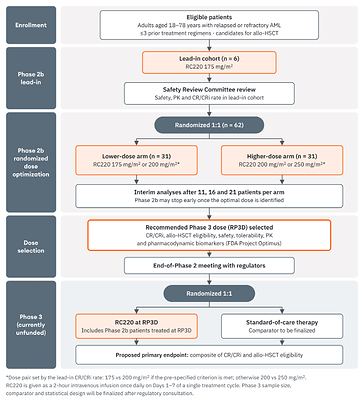
Phase 2b begins with a six-patient lead-in cohort at 175 mg/m2. Following Safety Review Committee (SRC) review, up to 62 additional patients will be randomized 1:1 (up to 31 per arm) to either 175 and 200 mg/m2 or 200 and 250 mg/m2, depending on the lead-in rate of complete remission (CR) or CR with incomplete hematologic recovery (CRi). In line with the US Food and Drug Administration’s (FDA) Project Optimus initiative, the recommended Phase 3 dose (RP3D) will be selected on CR/CRi rate, allo-HSCT eligibility, safety, tolerability, pharmacokinetics and pharmacodynamic biomarkers.
Interim analyses after 11, 16 and 21 patients per arm allow Phase 2b to end early. Racura expects Phase 2b to take 18 to 24 months, depending on recruitment, site activation and the number of patients needed to identify the optimal dose.
Progression to the Phase 3 stage is subject to Phase 2b results, additional funding and an End-of-Phase 2 meeting with regulators. Under the same protocol, Phase 3 is designed to randomize patients 1:1 to RC220 at the RP3D or standard-of-care therapy, with the Phase 2b patients treated at the RP3D included in the Phase 3 RC220 analysis. The proposed primary endpoint is a composite of CR/CRi and allo-HSCT eligibility. Sample size, comparator and statistical design will be finalized after regulatory consultation.
Clinical and Scientific Rationale
RC110, an earlier formulation of (E,E)-bisantrene, was evaluated in two Sheba studies led by Professor Arnon Nagler, the EMILI Principal Investigator. In 10 patients with R/R AML who had received a median of three prior lines of therapy, RC110 monotherapy at 250 mg/m2, given on the same seven-day, daily 2-hour infusion schedule as EMILI, produced four clinically meaningful responses (40%; one complete and three partial remissions; Canaani et al., Eur J Haematol 2021). Combined with fludarabine and clofarabine in 21 treated patients, RC110 produced clinically meaningful responses in 6 of 15 evaluable patients (40% of evaluable), including five complete remissions with six patients proceeding to allo-HSCT within one to three months (Danylesko et al., Br J Haematol 2025). Together with the 1988 approval of an earlier bisantrene formulation for AML in France, these small, single-center, non-randomized studies informed the bridge-to-transplant design of EMILI, but do not predict its outcome. Unlike RC110, which required a central line, RC220 is formulated for peripheral-vein infusion and showed drug exposure equivalent to RC110 in a nonclinical GLP bridging study reported on 17 November 2026.
In a collaborative preclinical study by the University of Newcastle and Racura, (E,E)-bisantrene reduced MYC gene and protein levels at nanomolar concentrations in most AML cell lines tested and prolonged survival in mouse models of AML, including a patient-derived xenograft model (Murray et al., bioRxiv 2026; preprint, not yet peer reviewed). Because leukemic cells circulate in the blood, exploratory biomarker analyses in EMILI can measure MYC protein and MYC-regulated gene expression in serial blood samples, avoiding the repeated biopsies required in solid tumors, and compare these changes with clinical outcomes. While MYC effects can be measured from the first patient, Racura expects 12 to 18 patients will be needed to determine whether RC220 suppresses MYC in patients. These findings could also inform the use of RC220 in the HARNESS lung cancer and CPACS solid tumor trials, where MYC plays an important role in cancer cell proliferation and treatment resistance and where serial tumor sampling is less practical.
Upcoming Milestones
Next steps include appointing a contract research organization, registering the trial on ClinicalTrials.gov, obtaining FDA clearance and European regulatory approval through the European Medicines Agency’s Clinical Trials Information System, and activating additional sites. All timelines are estimates and subject to change.
About RC220
RC220 is Racura’s proprietary peripheral-intravenous formulation of (E,E)-bisantrene, a small-molecule anticancer agent that binds G-quadruplex DNA and RNA structures and inhibits MYC gene expression in preclinical models. RC220 has received FDA Orphan Drug Designation for AML, which provides eligibility for seven years of US market exclusivity upon approval, and Racura has filed composition-of-matter patent applications that, if granted, could provide up to 20 years of protection for (E,E)-bisantrene.
About Racura Oncology
Racura Oncology (ASX: RAC) is a clinical-stage biopharmaceutical company based in Sydney, Australia, with a mission to silence cancer. Racura is developing RC220 in three clinical programs: the EMILI Phase 2b/3 trial in AML, the HARNESS Phase 1 trial with osimertinib in EGFR-mutant non-small cell lung cancer, and the CPACS Phase 1 trial with doxorubicin, which aims to provide both anthracycline cardioprotection and enhanced anticancer activity.
Racura has collaborated with institutions including MD Anderson Cancer Center, Emory University, Purdue University, the University of North Carolina School of Medicine, Sheba Medical Center and Astex. Learn more at www.racuraoncology.com.
Forward-Looking Statements
Some of the statements in this press release are forward-looking statements within the meaning of Section 27A of the Securities Act of 1933, Section 21E of the Securities Exchange Act of 1934 and the Private Securities Litigation Reform Act of 1995, which involve risks and uncertainties. Forward-looking statements in this release include, without limitation, statements regarding the timing of governance approval, site activation and first patient dosing in the EMILI trial; planned regulatory submissions and site activations in the United States, Europe and Australia; the expected duration of the Phase 2b stage; the potential of RC220 to suppress MYC or induce remissions in patients; and progression to, and funding of, the Phase 3 stage. These statements relate to future events, future expectations, plans and prospects. Although Racura believes the expectations reflected in such forward-looking statements are reasonable as of the date made, expectations may prove to have been materially different from the results expressed or implied by such forward-looking statements. Racura has attempted to identify forward-looking statements by terminology including “believes”, “estimates”, “anticipates”, “expects”, “plans”, “projects”, “intends”, “potential”, “may”, “could”, “might”, “will”, “should”, “approximately” or other words that convey uncertainty of future events or outcomes. These statements are only predictions and involve known and unknown risks, uncertainties and other factors, including delays in institutional, ethics or regulatory approvals (including from the FDA and EMA), the rate of patient recruitment, the results of the EMILI trial, the need for additional funding to conduct the Phase 3 stage, and market and other conditions. Any forward-looking statements contained in this press release speak only as of its date. Racura undertakes no obligation to update any forward-looking statements contained in this press release to reflect events or circumstances occurring after its date or to reflect the occurrence of unanticipated events, except as required by law.
 View original content to download multimedia:https://www.prnewswire.com/news-releases/racura-oncology-receives-first-site-approval-for-seamless-phase-2b3-emili-trial-of-rc220-in-relapsed-or-refractory-acute-myeloid-leukemia-302943640.html
SOURCE Racura Oncology Limited


