
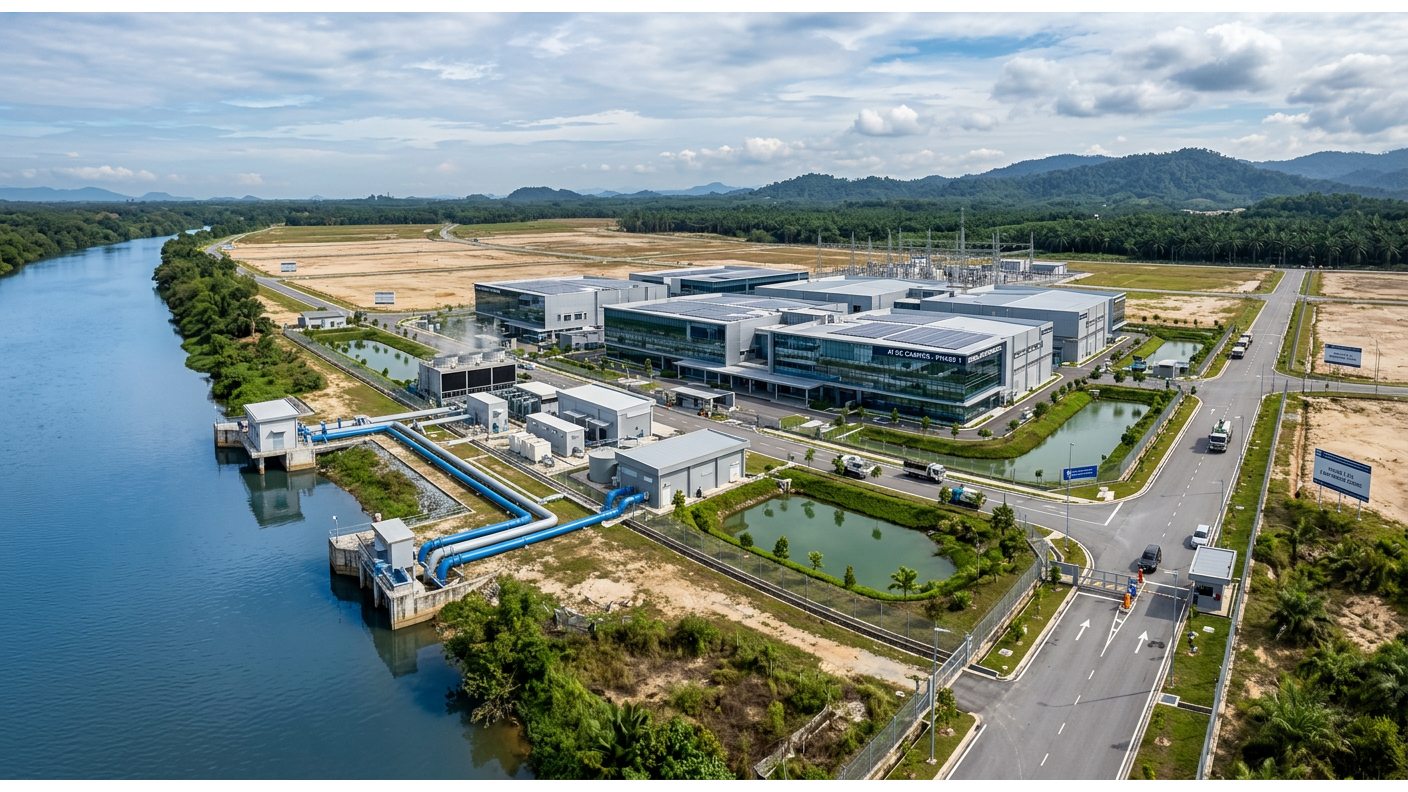
Malaysia’s data centre story is moving beyond the number of servers it can host. The revealing question is how computing campuses can support industry while using electricity and water responsibly. That shift gives investors a reason to examine emerging locations alongside the established momentum surrounding Johor.
The Economist’s supplied write-up explains why Johor attracted investment: competitive land, dependable energy and a welcoming policy environment. It also describes Malaysia’s desire to move towards research, skilled jobs and domestic supply chains. Those ambitions make campus design and location increasingly relevant to the value generated by each development.
Sungai Samak Estate introduces a land proposition in Tanjong Malim. Its website, https://sgsamak.com, markets five plots totalling 376 acres near Proton City and Universiti Pendidikan Sultan Idris. For readers following Malaysia data centre investment, the attraction is a setting where computing infrastructure could be considered alongside automotive activity and education.
That does not make Tanjong Malim a substitute for everything Johor already offers. It creates a different starting point for investigation. A campus close to manufacturing users might support vehicle simulation, production analysis or engineering collaboration, provided commercial demand, suitable infrastructure and an executable development plan can be demonstrated.
Low latency deserves attention. A nearby campus can shorten physical distance, but milliseconds depend on the route data actually takes. Fibre connections, network resilience and service providers matter more than a highway map. Any development marketed around responsive AI services should therefore be supported by measured connectivity and performance commitments.
Water planning can be just as decisive. In a well designed liquid cooling system, coolant collects heat from powerful processors and transfers it through heat exchangers. The cooled fluid then returns to the servers. Repeated circulation reduces the need for fresh intake compared with systems that continually replace discharged cooling water.
The environmental benefit depends on the entire cooling arrangement. Dry heat rejection can limit evaporative losses, while cooling towers consume water through evaporation and require controlled discharge. Treated reclaimed water can reduce drinking water demand where its quality suits the equipment. Recycling improves resource efficiency; it does not eliminate every loss.
The supplied estate materials describe access to water, but available quantities, permits and treatment needs remain matters for verification. Developers would need seasonal assessments and a clear water balance. That work would show how much water enters the system, how much is reused and where unavoidable losses occur.
Onsite renewable generation adds another layer to campus planning. Solar installations and storage could complement grid power, subject to land suitability, electrical design and approvals. The objective should be a credible supply strategy with dependable operation and measurable emissions performance, rather than an assumption that sunshine alone can power continuous computing.
Together, these considerations distinguish a thoughtful land assessment from a simple race for capacity. Sungai Samak Estate’s proposition is the possibility of coordinating industrial uses, computing, energy and cooling from the outset. Readers exploring acquisition or development can enquire at https://sgsamak.com/contact-us. The next Malaysia data centre story may emerge from how these pieces are assembled.
Sungai Samak Estate
2 Jalan Sempurna off Jalan Gombak
Kuala Lumpur
Federal Territory
53000
Malaysia


