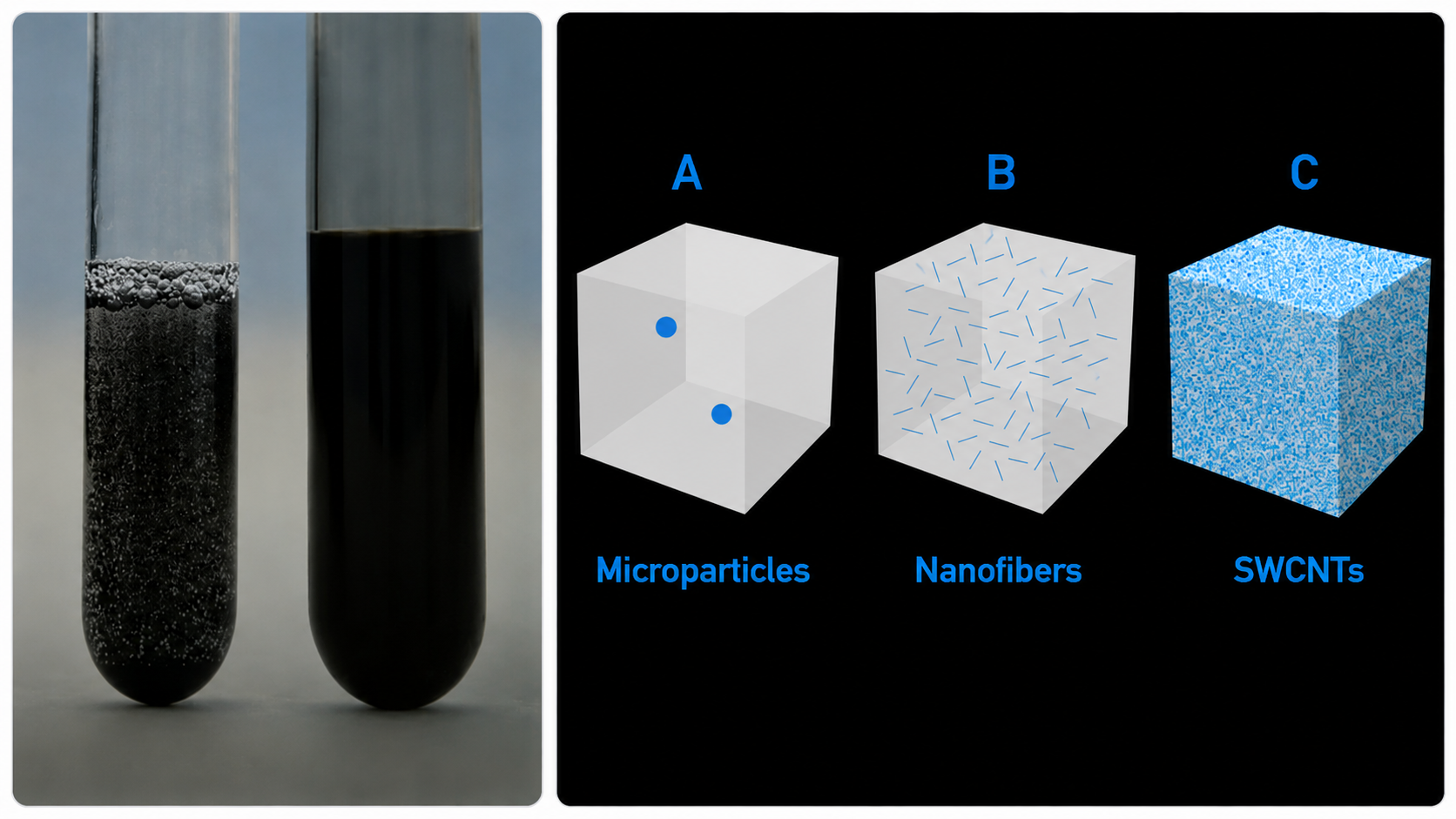
HANGZHOU, ZHEJIANG, CHINA, September 4, 2026 /EINPresswire.com/ — Manufacturing high-performance advanced nanomaterials such as pristine few-layer graphene, carbon nanotubes (CNTs), and structural nanoceramics presents severe colloidal engineering and scale-up bottlenecks. Because these nano-scale materials possess immense specific surface areas and extreme interparticle van der Waals attraction, conventional high-shear mixers and media bead mills struggle to de-agglomerate clusters without inducing severe crystal lattice damage, shortening nanotube aspect ratios, or introducing heavy metallic wear debris. Deploying dedicated graphene and carbon nanotubes ultrasonic dispersion systems applies intense acoustic cavitation that overcomes cohesive van der Waals forces through non-destructive fluid micro-jets, yielding monodisperse suspensions with long-term kinetic stability. Hangzhou Precision Machinery Co., Ltd. (JH) engineers high-power industrial ultrasonic processors and continuous circulation systems designed to deliver repeatable acoustic energy transfer, preserve nanomaterial morphology, and support large-scale continuous commercial production.
Mastering industrial-scale nanomaterial dispersion at JH requires a rigorous chemical engineering methodology that deconstructs the physical mechanisms of nano-scale re-agglomeration. Traditional mechanical dispersion methods fail because macroscopic rotor blades and colliding ceramic grinding beads apply localized impact forces that fracture fragile 2D graphene sheets and sever 1D carbon nanotube backbones into low-aspect-ratio fragments. To resolve this fundamental material science challenge, JH engineers developed a cohesive equipment architecture based on pressurized 20kHz acoustic flow cells, intelligent automatic resonance tracking, and real-time double-jacketed temperature regulation that together peel and disperse nanomaterials with atomic-level precision.
The Thermodynamic Challenge of Van der Waals Agglomeration and Mechanical Fracture
At the nanometer scale, the physical behavior of materials is governed by attractive van der Waals forces that scale inversely with particle diameter. For materials such as graphene sheets and carbon nanotubes with specific surface areas exceeding 500 to 1,000 square meters per gram, cohesive forces form dense, tightly bound agglomerates and entangled bundles that resist conventional fluid mixing. When introduced into liquid solvents, these nano-structures rapidly re-agglomerate into thermodynamically favored macroscopic clusters, causing rapid sedimentation, viscosity spikes, and loss of electrical and thermal conductivity.
Attempting to break these cohesive forces with mechanical ball mills or high-pressure micro-fluidizers introduces severe structural damage. Excessive mechanical milling introduces structural defects, tears graphene basal planes into defective amorphous carbon, and contaminates high-purity slurries with metallic bead wear fragments. In ceramic nanocomposites such as nano-alumina, zirconia, and silicon carbide, mechanical grinding creates broad particle size distributions that induce micro-cracks and structural weaknesses during sintering.
Acoustic Cavitation Micro-Jet Exfoliation and Non-Destructive De-Bundling Kinetics
High-power ultrasonic dispersion resolves the dilemma between shear intensity and structural preservation by utilizing the acoustic cavitation of liquid media. When 20kHz acoustic waves propagate through a liquid suspension, alternating high-pressure and low-pressure acoustic cycles nucleate millions of sub-microscopic vapor cavities. As these cavitation bubbles grow and reach critical resonance size, they collapse violently and asymmetrically, producing localized shockwaves and high-velocity acoustic micro-jets exceeding 1,000 km/h.
In liquid-phase graphene production, these acoustic micro-jets wedge directly into the interlayer galleries of natural graphite flakes, peeling individual graphene sheets apart layer-by-layer without breaking in-plane carbon-carbon covalent bonds. In carbon nanotube processing, cavitation fluid shears overcome strong inter-tube cohesive forces to disentangle tightly wound single-walled and multi-walled CNT bundles into continuous, single-dispersed networks without severing their high aspect ratios or degrading long-chain structures. This non-destructive mechanism facilitates high-concentration CNT dispersions that dramatically enhance electrical antistatic properties, thermal stability, corrosion resistance, and mechanical wear endurance across conductive plastics, adhesives, anti-static automotive panels, and protective polymer matrices.
Pressurized In-Line Flow Cells and Modular Industrial Circulation Architecture
Translating laboratory ultrasonic exfoliation into commercial multi-ton production requires replacing open batch beakers with sealed, pressurized continuous flow reactors. For laboratory R&D and pilot validation, dedicated benchtop inline flow-cell systems integrate a precision ultrasonic controller, titanium probe, flow chamber, peristaltic pump, and mixing tank, perfectly replicating industrial flow dynamics so test data can be linearly scaled up to full production skids. Operating under controlled hydraulic backpressures up to 0.6 MPa, these sealed reactors suppress acoustic decoupling, compress cavitation bubble dynamics, and maximize energy transfer directly into passing fluid streams.
To achieve high-tonnage daily throughputs, JH configures 2.0kW, 3.0kW and 5.0kW flow-cell processors into modular multi-unit ultrasonic homogenizer production skids. Connecting flow cells in series subjects passing nanomaterial slurries to sequential, cumulative cavitation stages, ensuring 100% of the fluid receives identical acoustic exposure without bypass dead zones. For mega-scale production lines, parallel manifold configurations distribute bulk slurry feeds evenly across synchronized reactor banks, allowing manufacturers to expand processing capacity linearly without altering validated formulation recipes.
Dynamic Resonance Tracking for High-Viscosity Nanomaterial Slurries up to 6,000 cP
A frequent technical barrier during large-scale nanomaterial dispersion is the dramatic rheological transformation of the fluid matrix. As carbon nanotubes de-bundle or graphene sheets exfoliate into liquid suspension, the newly exposed interfacial surface area causes dynamic viscosity to surge, often reaching 3,000 to 6,000 cP. This viscosity increase dampens acoustic wave propagation and shifts the electrical impedance of the ultrasonic homogenizer assembly, causing conventional analog power supplies to lose resonance and stall.
JH large-scale industrial systems overcome acoustic impedance shifts through intelligent digital frequency-tracking generators that continuously monitor circuit resonance and auto-tune operating frequency around 20kHz in real time. This rapid dynamic tracking ensures that the ultrasonic homogenizer constantly operates at peak electromechanical efficiency, even during severe viscosity transitions up to 6,000 cP. Integrated digital controls permit stepless amplitude regulation from 30% to 100%, allowing process engineers to calibrate acoustic power density precisely to formulation requirements.
Double-Jacketed Cooling and Medical Titanium Metallurgy for 24/7 Continuous Duty
Because acoustic cavitation converts high electrical energy into fluid heat, continuous industrial sonication generates substantial thermal loads that can cause solvent boiling, polymer degradation, or rapid re-agglomeration of exfoliated nanomaterials. JH continuous flow-cell reactors feature integrated double-jacketed cooling chambers that circulate chilled water or glycol, dissipating excess process heat and maintaining slurry temperatures strictly below 100°C during continuous multi-ton operations.
To resist cavitation pitting and chemical corrosion, JH precision-machines all industrial horns from certified medical-grade titanium alloy. This robust metallurgy ensures exceptional acoustic velocity transmission, high tensile fatigue strength, and complete freedom from metal spalling or particulate contamination. Combined with sanitary quick-connect tri-clamp fittings and full automated Clean-in-Place (CIP) and Sterilize-in-Place (SIP) compatibility, JH industrial systems deliver dependable round-the-clock operation across advanced battery, electronics, and aerospace manufacturing facilities.
Conclusion
Achieving reproducible, large-scale dispersion of graphene, carbon nanotubes, and nanoceramics demands a scientifically engineered equipment architecture that combines high-power 20kHz cavitation, pressurized flow-cell hydrodynamics, automatic frequency tracking, and robust temperature management. With 15 years of dedicated acoustic engineering expertise, CE certification, and modular multi-unit ultrasonic homogenizer skid designs, JH provides global advanced materials manufacturers with turnkey industrial dispersion systems built for high-volume commercial reliability. All standard equipment is supported by a comprehensive 2-year warranty, fast 2-week dispatch availability, and dedicated lifetime technical support for seamless factory integration.
To request detailed technical specifications for graphene and carbon nanotube ultrasonic dispersion systems, flow-cell engineering CAD drawings, pilot testing reports, or custom multi-unit ultrasonic homogenizer production skid quotations for your manufacturing plant, visit the official company portal: https://www.hzpmsonic-en.com/. For direct engineering consultations regarding acoustic power density matching, inline manifold design, fluid viscosity handling, and turnkey plant integration, contact the technical sales department.
hangzhou precision machinery co.,ltd.
hangzhou precision machinery co.,ltd.
13600541971
email us here
Visit us on social media:
Facebook
YouTube
Legal Disclaimer:
EIN Presswire provides this news content “as is” without warranty of any kind. We do not accept any responsibility or liability
for the accuracy, content, images, videos, licenses, completeness, legality, or reliability of the information contained in this
article. If you have any complaints or copyright issues related to this article, kindly contact the author above.

Media gallery