Key Takeaways:
- Aluminum utility trailers, enclosed cargo trailers, and tilt trailers are the three best options for hauling a golf cart – each suited to different hauling habits and protection needs.
- Most standard two-seater golf carts (500-1,100 lbs) fit comfortably on a single-axle trailer with a 10-14 ft bed, but lifted carts, four-seaters, and multi-cart loads require stepping up in size.
- Interior height on enclosed trailers is a commonly overlooked spec – one that can make or break fitment for lifted carts or carts with roof canopies.
- Securing the cart properly – anchoring ratchet straps to manufacturer-recommended frame attachment points, with at least four straps total – is just as important as choosing the right trailer type.
Picking the wrong trailer for a golf cart is an easy mistake when the options look similar on paper. The difference between a smooth haul and a stressful one usually comes down to three factors: how the cart loads, how well it’s protected in transit, and whether the trailer’s weight capacity actually matches the cart.
The breakdown below covers all three trailer types that consistently deliver on those fronts, along with the specs and features that matter most.
Golf Cart Size & Weight Determine Your Trailer Match
Before comparing trailer types, it helps to know what’s actually being hauled. A standard two-seater gas golf cart typically weighs 650 to 950 lbs and measures roughly 48 inches wide by 96 inches long. Electric carts with lead-acid batteries push that closer to 1,000-1,100 lbs, while lithium-battery models tend to weigh 150-250 lbs less than their lead-acid counterparts due to lighter battery packs. Four-seater and six-seater carts are longer (up to 144 inches) and wider (up to 54 inches), so they need a 10 to 14 ft trailer bed at minimum.
A useful general rule: the trailer bed should be at least 2 feet longer than the cart being hauled. That extra length provides room to position tie-downs properly and keeps the cart from hanging over the edge during loading. Any trailer with a GVWR of 2,990 lbs or higher will safely carry a single standard cart – but that number should account for tie-downs, ramps, and any gear loaded alongside it, not just the cart itself. The National Association of Trailer Manufacturers (NATM) recommends a full trailer safety inspection before every towing trip, which starts with confirming that GVWR figure against actual loaded weight.
Aluminum Utility Trailers: Corrosion-Resistant, Capable Haulers
Aluminum utility trailers are the most popular choice for golf cart owners who want a reliable, no-fuss hauler. The open design makes loading and unloading fast, the weight stays low enough to tow behind most half-ton trucks or larger SUVs, and aluminum construction means zero rust concerns – even after years of wet roads and salted highways.
Payload Capacity & GVWR to Know
The Aluma 7816ESA-TA-EL-BT (78 in x 16 ft) is a strong benchmark for this category. It runs dual 3,500 lb rubber torsion axles with electric brakes, a 7,000 lb GVWR, and a 5,950 lb payload capacity – well beyond what a single golf cart demands, which leaves room for tools, coolers, or a second cart. At 1,050 lbs trailer weight, it still tows comfortably behind common half-ton tow vehicles. The GVWR should comfortably exceed the total hauled load as a safety margin; this model clears that threshold with room to spare for nearly every golf cart configuration.
Bi-Fold Tailgate vs. Standard Ramp
The Aluma 7816ESA-TA-EL-BT uses an aluminum bi-fold tailgate (77.5 in x 60 in) rather than a separate ramp. When folded down, it creates a low-angle loading surface most golf carts can climb under their own power – no maneuvering a ramp into position, no storing it separately. Standard utility trailers with bolt-on ramps work fine, but the bi-fold design is noticeably faster for owners who load and unload frequently. Six tie-down loops (three per side) and two rear stabilizer legs round out the practical features.
Enclosed Cargo Trailers: Maximum Protection on the Road
Enclosed cargo trailers are the right call when the cart needs full protection – during long-distance transport, overnight storage away from home, or any haul where weather and road debris are a real concern. The enclosed structure shields against rain, UV exposure, and theft in ways an open trailer simply cannot.
Interior Height: The Spec Lifted Cart Owners Miss
Interior height is the spec that catches buyers off guard. Standard 6 x 12 ft enclosed trailers offer around 6 ft 3 in of interior clearance. The Anvil 6 x 12 ft Single Axle Enclosed Cargo offers an upgraded 6 ft 6 in interior height option, which covers most stock golf carts. Lifted carts, carts with roof canopies, or models with aftermarket accessories often need the 7 ft interior height found on tandem axle models like the Anvil 7 x 16 ft (around $7,988). Measuring the cart’s actual loaded height – roof, antenna, any installed accessories – before buying an enclosed trailer is non-negotiable.
Best Sizes for Single vs. Multiple Carts
For single-cart transport, the Anvil 6 x 12 ft (around $5,488) handles most standard two-seaters with a rear ramp door and .080 Polycore exterior. Buyers transporting two carts – or contractors and fleet managers moving multiple units – typically move to the 8.5 x 20 ft enclosed configuration (around $9,998), which provides enough width and length to load two carts side by side or in tandem depending on setup. Enclosed trailers cost more upfront, but for high-value custom carts or regular long-haul transport, that premium pays off quickly.
Tilt Trailers: Drive On, Strap Down, Go
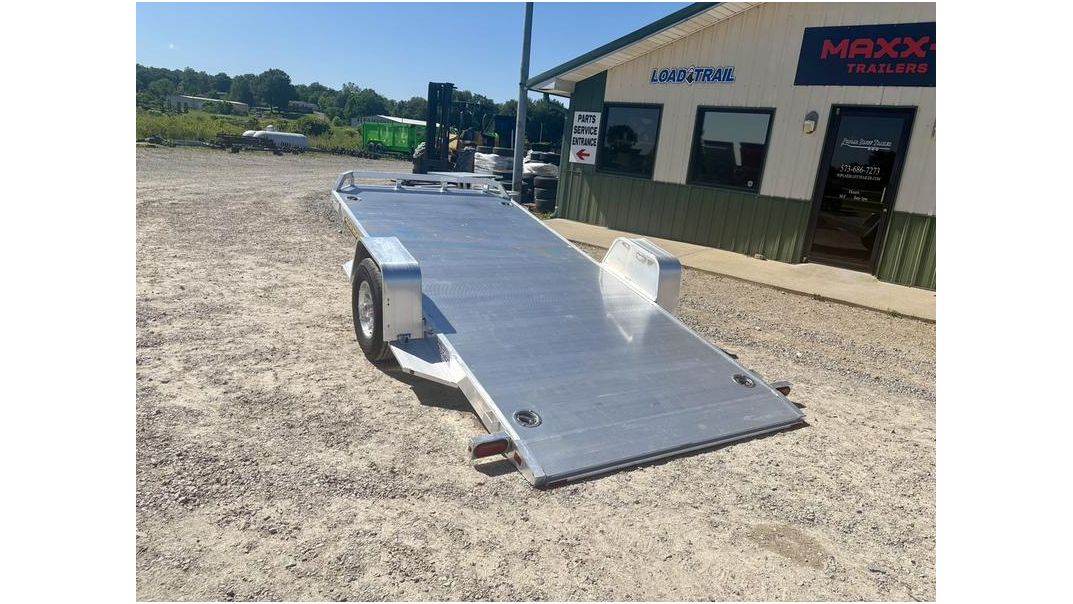
Tilt trailers solve the loading problem entirely. There’s no ramp to unfold, no steep angle to manage – the bed itself tilts down to ground level, the cart drives on, and the bed locks flat for transport. That fast load-and-go experience is why golf course maintenance crews and dealers moving inventory consistently prefer this style.
How the Hydraulic Tilt Mechanism Works
The Aluma 8214H-TILT-S-EL-RTD (82 in x 14 ft) uses a hydraulic dampener with gas lift to control the tilt angle – 12 degrees on this model. The wider 82 in bed gives extra clearance on both sides of the cart, which makes strapping faster and reduces the risk of contact with the trailer sides during loading. It carries a 5,200 lb GVWR with electric brakes and a 4,136 lb payload capacity. For lighter or less frequent loads, the Aluma 7712H-TILT-S (77 in x 12 ft) weighs approximately 650-700 lbs on a single 3,500 lb torsion axle with a 2,990 lb GVWR and a 15-degree tilt – more than enough for a standard two-seater gas or electric cart. Both models use aluminum construction throughout, keeping corrosion resistance and towing weight in check over the long haul.
Size & Weight Capacity: How to Match Trailer to Cart
For most single-cart setups, a 5 x 10 ft or 6 x 12 ft trailer handles a standard two-seater. Step up to a 78 in x 14 ft bed if the cart carries rear cargo boxes, a light bar, or a lift kit – accessories add both height and length that affect how safely the cart sits on the trailer. Two-cart haulers should look at 8.5 x 20 ft enclosed models or tandem-axle utility trailers in the 16 to 22 ft range.
Gas vs. Electric Cart Weight Differences
Gas carts (650-950 lbs) and lithium-battery electric carts behave similarly on a trailer, with lithium models typically running 150-250 lbs lighter than lead-acid equivalents. Lead-acid electric carts are the outlier – pushing 1,000-1,100 lbs – and that extra weight matters when choosing between a light single-axle trailer and a heavier-duty tandem. Any trailer with a GVWR comfortably above 2,990 lbs handles a single cart, but centering the cart on the trailer for balanced weight distribution is just as important as the GVWR number itself. Poor centering overloads the hitch and can cause dangerous trailer sway at highway speeds.
Features That Make or Break Golf Cart Hauling
Tie-Down Points: Frame Anchoring Rules
Tie-down placement is where many haulers cut corners. The cart should always be secured using manufacturer-recommended attachment points on the trailer frame, with at least four high-quality ratchet straps – one at each corner. Aluma tandem-axle utility trailers include six tie-down loops (three per side) as standard, while enclosed models add D-ring tie-downs on the floor. Before every trip, all loose cart accessories – windshields, storage baskets, golf bags – should be removed or secured to prevent road hazards.
LED Lighting, Torsion Axles & Construction Material
Rubber torsion axles absorb road vibration better than leaf spring setups, which benefits all cargo and contributes to a smoother ride overall. LED lighting packages improve road visibility and are standard on most quality utility and tilt trailers. Aluminum construction keeps trailer weight low while resisting corrosion – critical for anyone hauling through wet conditions regularly. Buyers hauling in cold or wet climates get added value from an enclosed trailer’s weather barrier; those prioritizing quick turnaround at a golf course tend to favor open utility or tilt configurations where access is instant.
Browse Live Dealership Inventory for All Three Types
Choosing between an aluminum utility trailer, an enclosed cargo trailer, and a tilt trailer comes down to how often the cart is hauled, how far it travels, and how much protection it needs along the way. Each type has a clear strength – versatility, security, or speed of loading – and the right trailer specs make the difference between a confident haul and a risky one. A dealer that stocks a variety of trailers will know the best for your purposes… based on your preferences and your budget.
Poplar Bluff Trailer
135 Hwy T Suite B
Poplar Bluff
Missouri
63901
United States