
The Merlin-662CRS is a 2MP Sony Starvis IMX662 USB 2.0 Camera built for OEM developers and system integrators who need HDR imaging and dual endpoint UVC streaming from a single compact USB connection, purpose built for edge AI vision systems, embedded vision USB camera deployments, security and video surveillance, smart city infrastructure, robotics and industrial automation, and access control platforms where a low light HDR USB camera with driverless UVC compliance simplifies host side integration across Windows, Linux and Android.
FORT WORTH, TX / ACCESS Newswire / July 27, 2026 / Vadzo Imaging, a global provider of embedded vision solutions, today announces the launch of the Merlin-662CRS, a 2MP Sony Starvis IMX662 USB 2.0 Camera. The Merlin-662CRS brings together HDR imaging, rolling shutter color capture and dual endpoint UVC streaming in a compact 38mm x 38mm form factor. Designed for integration into edge AI vision systems, security and video surveillance networks, smart city infrastructure and robotics platforms, the Merlin-662CRS delivers driverless UVC video transmission across Windows, Linux and Android in a single production-ready board.
Sensor and Camera Overview
The Merlin-662CRS is built on the Sony IMX662 Color 1080p HDR USB Camera sensor platform, the Sony Starvis 2 IMX662, a back-illuminated CMOS image sensor with a 1/2.8 inch optical format, 2.9 µm x 2.9 µm pixel pitch, and a maximum resolution of 2MP (1920 x 1080). Sony Starvis 2 is Sony’s next-generation back-illuminated pixel architecture that positions the photodiode layer on the light-receiving side of the chip, increasing photon capture efficiency compared to front-illuminated sensors of the same physical size. This translates into sharper images at low light levels, reduced noise across the video stream, and stronger near-infrared sensitivity without requiring additional illumination. As a color 2MP rolling shutter USB 2.0 camera, the IMX662 captures full color frames by reading pixel rows sequentially, an approach well suited to stationary and slow-moving subjects across a wide range of embedded vision USB camera deployments.
The IMX662 sensor supports high dynamic range capture at the sensor level through both Digital Overlap HDR and Clear HDR functions, giving the Merlin-662CRS the ability to preserve detail across scenes containing both bright highlights and deep shadow regions simultaneously, a common requirement for a wide dynamic range USB camera operating near windows, doorways, or mixed indoor and outdoor lighting. As an IMX662 HDR USB camera, the Merlin-662CRS extends usable dynamic range beyond what a standard exposure capture can deliver, reducing the need for host-side tone mapping or exposure bracketing in downstream image processing pipelines.
On the interface side, the Merlin-662CRS operates as a USB 2.0 camera module with full UVC compliance, meaning the camera product operates without proprietary host drivers on Windows, Linux and Android. Beyond standard UVC operation, the Merlin-662CRS is engineered as a dual endpoint USB camera, exposing two independent UVC video streaming endpoints from a single physical USB 2.0 connection. This allows a host system to pull two concurrent video streams, for example a primary stream for recording or display and a secondary stream sized for real-time edge AI inference, without requiring the host to duplicate, transcode, or downscale a single feed in software. For OEM developers building an edge AI USB camera pipeline, dual endpoint streaming removes a layer of host-side video processing that would otherwise consume CPU cycles better spent on inference workloads. The camera product operates across a -30°C to +85°C temperature range in a compact 38mm x 38mm board, suited to space-constrained OEM enclosures.
Key specs: 2MP (1920 x 1080) | IMX662 Sony Starvis 2 | 1/2.8″ | 2.9 µm | Rolling Shutter | Color | HDR (Digital Overlap HDR and Clear HDR) | USB 2.0 UVC with Dual Endpoint Streaming | S-Mount (M12 Standard) | -30°C to +85°C Operating Temperature | 38mm x 38mm | Windows · Linux · Android | UVC, RoHS 3, REACH
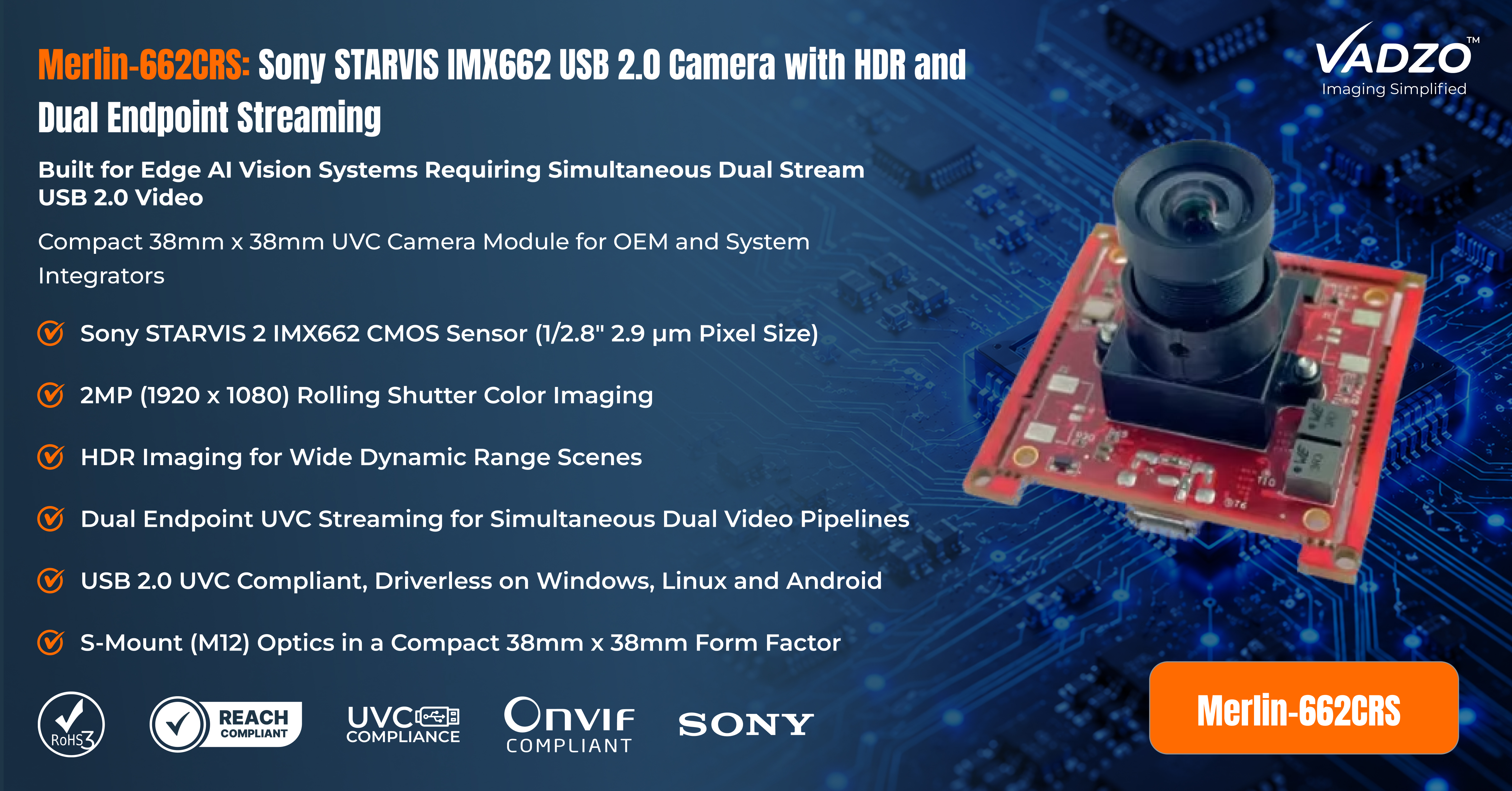
Key Capabilities of the Sony IMX662 USB 2.0 HDR Camera
Dual Endpoint UVC Streaming for Simultaneous Edge AI Pipelines: The defining architectural feature of the Merlin-662CRS is its dual endpoint streaming design, which exposes two independent UVC video streaming endpoints from a single USB 2.0 connection. In a standard single-endpoint UVC camera, a host application must open one video stream and then duplicate or resize that stream in software if a second consumer, such as a display pipeline and an inference engine, needs a differently sized or differently encoded feed. The Merlin-662CRS instead presents two addressable streaming endpoints directly at the USB descriptor level, so two host-side applications can each open an independent stream sized and formatted for its own purpose. As a multi-stream USB camera and a UVC dual endpoint camera, this reduces CPU load on the host and cuts latency for the edge AI vision camera pipeline that depends on a fast, dedicated feed for real-time inference rather than a feed shared with a recording or display path.
HDR Imaging with the Sony STARVIS 2 IMX662 Sensor: High contrast scenes, such as a loading dock with a bright exterior door and a dim interior, or a retail aisle lit unevenly by overhead fixtures and window light, routinely exceed the dynamic range of a standard exposure sensor. The Sony Starvis 2 IMX662 at the core of the Merlin-662CRS addresses this at the sensor level, supporting both Digital Overlap HDR, which combines long and short exposure rows within a single readout cycle, and Clear HDR, which is designed to reduce the motion artifacts commonly associated with multi-exposure HDR capture. For a low-light HDR USB camera used in access control, retail analytics, or robotics navigation, this dynamic range headroom means fewer blown-out highlights and fewer crushed shadow regions in the same frame, without requiring the host application to apply software-side tone mapping after capture. Vadzo’s broader HDR USB camera portfolio spans multiple sensor formats and interface types for teams standardizing on wide dynamic range imaging across a product line.
Rolling Shutter Color Imaging at 2MP Resolution: The Merlin-662CRS captures full color 1080p video using the Sony IMX662’s rolling shutter readout, which scans pixel rows sequentially rather than exposing the entire frame at once for stationary and slow-moving subjects, which describes the majority of fixed installation USB camera deployments in security, smart city, and robotics contexts, rolling shutter readout delivers full resolution color detail without the additional sensor complexity and cost associated with global shutter designs. As a 2MP rolling shutter USB 2.0 camera, the Merlin-662CRS resolves fine detail across a 1920 x 1080 frame, supporting use cases from facial detail capture at access points to short-range identification tasks, while the back-illuminated pixel architecture of the IMX662 preserves signal-to-noise performance as ambient light drops through the day.
S-Mount Optics in a Compact Board Level Form Factor: The Merlin-662CRS ships in a 38mm x 38mm board-level form factor with S-Mount (M12 Standard) optics, giving OEM developers the flexibility to pair the camera product with lenses suited to their specific field of view, working distance, and low-light aperture requirements. Because the lens mount follows the widely adopted M12 standard, integrators are not locked into a single optics vendor and can source lenses appropriate to indoor kiosk deployments, outdoor traffic monitoring installations, or close-range robotics navigation tasks. For teams comparing lens mount options across a camera portfolio, Vadzo’s guide on S-Mount vs C-Mount vs CS-Mount lens selection outlines the tradeoffs relevant to compact embedded vision USB camera integration.
UVC Driverless Operation Across Windows, Linux and Android: Full UVC compliance means the Merlin-662CRS operates as a driverless embedded vision USB camera across Windows, Linux and Android host platforms, without requiring a proprietary kernel driver or custom installation package. For OEM teams building products that must support multiple host operating systems from a single hardware SKU, UVC compliance removes a substantial category of platform-specific driver validation work. Combined with dual endpoint streaming, the Merlin-662CRS functions as a UVC dual endpoint camera that any standard UVC capture application can address immediately, while a secondary endpoint remains available for a dedicated edge AI inference pipeline running on the same host.
Product Specifications
|
Model |
Merlin-662CRS |
|
Image Sensor |
Sony STARVIS 2 IMX662 (Color, Back-Illuminated CMOS) |
|
Optical Format |
1/2.8″ |
|
Pixel Size |
2.9 µm x 2.9 µm |
|
Max Resolution |
2MP (1920 x 1080) |
|
Shutter Type |
Rolling Shutter |
|
HDR |
Digital Overlap HDR and Clear HDR (sensor level) |
|
Interface |
USB 2.0 Micro B Interface |
|
Streaming |
Dual Endpoint UVC Streaming |
|
Optics |
S-Mount (M12 Standard) |
|
Operating Temperature |
-30°C to +85°C |
|
Dimensions |
38mm x 38mm |
|
Platform Support |
Windows, Linux, Android |
|
Compliance |
UVC, RoHS 3, REACH |
“Edge AI systems rarely need just one video stream from a camera product; they need one stream for the person or system that has to see the scene and a second stream tuned for the model that has to interpret it. With the Merlin-662CRS, we wanted to solve that at the hardware level instead of leaving it to host-side software. Pairing dual endpoint UVC streaming with the Sony IMX662’s HDR performance means integrators get a genuinely wide dynamic range image and two independently addressable video paths from one USB 2.0 connection, without writing a custom driver or a software layer to split the feed. For OEM teams building edge AI vision systems on Windows, Linux, or Android, that combination removes real integration work.” – Alwin Vincent, Product Manager at Vadzo Imaging.
Target Applications
Security and Video Surveillance: Continuous monitoring across retail floors, building entrances, and perimeter zones requires a smart surveillance USB camera capable of holding image quality steady as lighting shifts between bright exterior daylight and dim interior corridors. The HDR capability of the Merlin-662CRS addresses the high-contrast conditions common at entryways and loading docks, while dual endpoint streaming allows a single camera product to feed a live monitoring display through one endpoint and a video analytics or motion detection pipeline through the other, without the host application needing to duplicate the feed. As a night vision USB camera candidate for low-light corridors and after-hours monitoring, the IMX662 sensor’s back-illuminated architecture extends usable imaging further into low light conditions than earlier generation sensors of the same pixel size. Teams building out a broader security and video surveillance deployment can pair the Merlin-662CRS with Vadzo’s wider USB camera portfolio for multi-camera installations spanning both HDR and standard dynamic range requirements.
Smart City, Traffic Monitoring and ANPR: Roadside and intersection deployments for traffic monitoring USB camera and ANPR camera systems must resolve vehicle detail and plate characters across a scene that includes both sunlit pavement and shadowed lane markings within the same frame. The Merlin-662CRS’s HDR imaging addresses this contrast range at the sensor level, while its compact 38mm x 38mm form factor and S-Mount optics suit integration into pole-mounted or in-vehicle enclosures common to smart city surveillance camera infrastructure. As a driver monitoring camera candidate for fleet and telematics platforms, the same dual endpoint streaming architecture that supports edge AI inference in fixed installations applies equally to in-cabin systems that need one stream for driver-facing analytics and a second for event recording. For teams building out ANPR or driver monitoring pipelines alongside broader fleet infrastructure, Vadzo’s telematics and fleet management resources outline additional integration considerations for edge AI vision systems deployed in vehicles.
Robotics and Industrial Automation: Mobile robotic platforms and fixed industrial inspection stations increasingly rely on an edge AI vision camera that can feed a navigation or inspection model directly without routing frames through a general-purpose capture library first. The Merlin-662CRS’s dual endpoint UVC streaming lets a robotics vision camera integration dedicate one endpoint to a locally running inference model handling obstacle detection or defect classification, while a second endpoint remains available for a supervisory display or remote monitoring station, both from the same USB 2.0 connection and without additional cabling. The compact board-level form factor and USB 2.0 interface keep power and connector requirements modest relative to higher bandwidth interfaces, a relevant consideration for battery-powered AMRs and compact robotic arms. As an embedded vision USB camera for automation and robotics deployments, the Merlin-662CRS’s rolling shutter color capture and HDR performance support consistent imaging across the variable lighting conditions typical of factory floors and warehouse aisles.
Retail Automation and Access Control: Self-checkout stations, shelf monitoring installations, and building entry systems require an access control USB camera that can capture consistent detail across a range of approach angles and ambient lighting without manual exposure adjustment. The Merlin-662CRS’s HDR performance helps hold detail steady as a person or vehicle moves from a bright exterior into a shaded entryway, a transition that frequently causes exposure-related dropouts in standard dynamic range camera products. Retail automation solutions built around shelf monitoring, queue analysis, or loss prevention can use the dual endpoint architecture to run an on-device analytics model on one stream while a second stream feeds a recorded archive for review, reducing the bandwidth and storage load that would otherwise fall on a central video management system. As a compact USB 2.0 camera module, the Merlin-662CRS integrates into kiosk enclosures and point of sale hardware without requiring the higher power budget associated with USB 3.2 interface camera products.
Kiosk and Self-Service Terminals: Outdoor and semi-outdoor kiosks, including ticketing terminals, parcel lockers, and self-service check-in stations, face lighting conditions that shift dramatically between direct sunlight and shaded overhang coverage throughout the day. The Merlin-662CRS’s HDR capability and IMX662 sensor sensitivity address the exposure swings typical of an outdoor kiosk camera deployment, while the -30°C to +85°C operating temperature range supports installation in unconditioned enclosures across a wide range of climates. Vadzo’s guide on the benefits of the IMX662 camera for outdoor kiosk deployments outlines additional considerations relevant to sensor selection for this application category. Kiosk and digital signage integrators building identity verification, age verification, or general user-facing capture into a terminal can rely on the Merlin-662CRS’s UVC compliance to avoid custom driver work across whichever host platform- Windows, Linux, or Android- the kiosk’s compute module happens to run.
Platform Support and SDK
The Merlin-662CRS operates as a fully UVC-compliant USB 2.0 camera module, meaning the camera product is recognized natively by Windows, Linux, and Android hosts using each platform’s built-in UVC class driver, without a proprietary installation package. Developers can begin capturing video immediately using any standard UVC-compatible capture application or framework available on their chosen platform. For engineers requiring access beyond standard UVC controls, Vadzo provides SDK access covering region of interest configuration, exposure and gain control, and firmware update management, allowing deeper integration for teams building custom edge AI or analytics pipelines around the camera product.
The dual endpoint streaming architecture is exposed at the UVC descriptor level, so both video streaming endpoints are visible to the host operating system as soon as the Merlin-662CRS is connected, without requiring a separate configuration step to activate the second stream. This lets developers building an edge AI vision camera pipeline address each endpoint independently from within their own application code, whether that means opening one endpoint in a standard UVC viewer for setup and diagnostics while a second endpoint feeds a headless inference process, or running two separate consumer applications side by side during development. For teams standardizing on a single interface across multiple camera variants, the Merlin-662CRS joins Vadzo’s broader USB 2.0 UVC camera portfolio, giving OEM developers a consistent host-side integration path across standard definition, full HD, and HDR configurations within the same product family.
Frequently Asked Questions
Q: What is dual endpoint streaming in a USB 2.0 camera and why does it matter for edge AI systems?
A: Dual endpoint streaming describes a USB Video Class camera design that exposes two independent video streaming endpoints from a single physical USB connection, rather than the single endpoint found on most standard UVC camera products. This lets a host system pull two simultaneous video streams, for example, a full-resolution stream for recording or display and a second stream sized for a machine learning model, without the host having to duplicate or resize a single feed in software. Vadzo Imaging’s Merlin-662CRS is a Sony Starvis IMX662 USB 2.0 Camera built around this dual endpoint architecture, giving OEM developers building edge AI vision systems a way to serve both a display path and an inference path from one camera product without additional host-side processing overhead.
Q: How does HDR improve image quality in a low-light USB camera?
A: HDR, or high dynamic range imaging, extends a sensor’s ability to capture detail across scenes that contain both very bright and very dark regions in the same frame, conditions that a standard exposure sensor typically resolves by either blowing out highlights or losing shadow detail. The Sony Starvis IMX662 sensor used in Vadzo Imaging’s Merlin-662CRS supports HDR capture at the sensor level, alongside strong low-light sensitivity inherited from its back-illuminated pixel architecture. For a low-light HDR USB camera deployed at entryways, loading docks, or mixed indoor and outdoor installations, this combination reduces the exposure-related dropouts that otherwise degrade footage as lighting conditions shift throughout the day.
Q: What is the difference between a rolling shutter and a global shutter USB camera?
A: A rolling shutter USB camera captures a frame by reading pixel rows sequentially from top to bottom, which suits stationary or slow-moving subjects and allows a more compact, cost-effective sensor design. A global shutter camera exposes every pixel at the same instant, better preserving fast-moving subjects but typically at a higher sensor cost for the same resolution. Vadzo Imaging offers both configurations across its USB camera portfolio, including rolling shutter options like the Merlin-662CRS for applications where subject motion is limited and full color detail at 2MP resolution is the priority.
Q: Does Vadzo Imaging provide SDK support for USB 2.0 UVC camera products?
A: Yes. Vadzo Imaging provides SDK access alongside standard UVC compliance for its USB 2.0 camera portfolio, including the Merlin-662CRS, covering region of interest configuration, exposure and gain control, and firmware update management for teams that need more than the default UVC control set. Because the Merlin-662CRS is fully UVC compliant, developers can begin capturing video immediately using any standard UVC-compatible application on Windows, Linux, or Android, and add SDK-level control later as their integration matures, without needing to redesign the host-side capture pipeline.
Q: Can Vadzo Imaging customize a USB 2.0 HDR camera for specific OEM integration requirements?
A: Vadzo Imaging supports hardware and firmware customization across its USB camera portfolio, including the Merlin-662CRS. Available customization options include lens and optics selection, enclosure design for outdoor or industrial deployment, firmware adjustments to streaming parameters and endpoint configuration, and board-level modifications for space-constrained OEM designs. Vadzo’s engineering team works directly with OEM customers integrating a Sony IMX662 USB Camera into a larger product, whether that means adapting the dual endpoint streaming configuration to a specific host application or validating the camera product against a particular edge AI compute platform, at any production volume.
Availability and Customization
The Merlin-662CRS Sony Starvis IMX662 USB 2.0 Camera is available now for OEM evaluation and production orders. Evaluation units ship with the camera board, a default S-Mount lens, and a USB cable, with no minimum order quantity for initial evaluation. Volume pricing, firmware customization, optics selection, and enclosure design services are available on request for OEM and system integrator programs. Engineering teams can view the full IMX662 Color 1080p HDR USB Camera product page for detailed specifications, or explore Vadzo’s broader HDR USB camera portfolio online and USB UVC camera portfolio, available through Vadzo’s online store. For inquiries or customization requests, contact the Vadzo Imaging sales team at support@vadzoimaging.com.
About Vadzo Imaging
Vadzo Imaging develops embedded vision camera products for OEMs and system integrators building production-ready vision systems. The company offers imaging platforms across USB, MIPI, GigE, Wi-Fi, and SerDes interfaces supporting applications in industrial automation, robotics, security and surveillance, smart city infrastructure, retail automation, and edge AI. Vadzo provides end-to-end imaging support including sensor integration, ISP tuning, firmware development and software frameworks that accelerate development and simplify system deployment. Visit www.vadzoimaging.com to explore the full embedded vision camera portfolio.
Media Contact
Alwin Vincent Vadzo Imaging Email: alwin@vadzoimaging.com LinkedIn: Vadzo Imaging YouTube: Vadzo Imaging X: Vadzo Imaging
SOURCE: Vadzo Imaging
View the original press release on ACCESS Newswire


