SHANNON, CLARE, IRELAND, May 22, 2026 /EINPresswire.com/ — Announcing a new publication from Opto-Electronic Sciences; DOI 10.29026/oes.2026.260011.
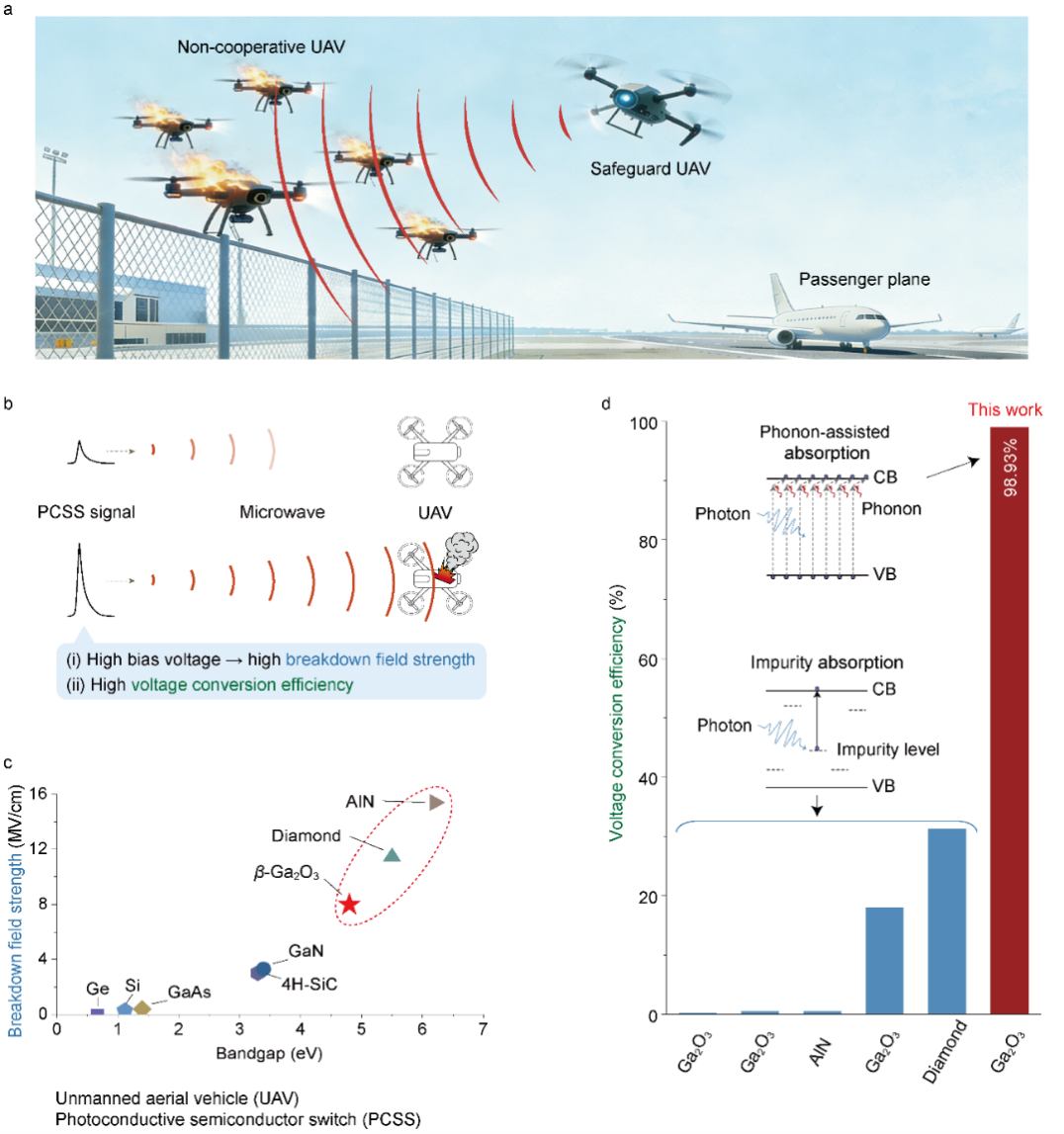
A authors of this article propose a photoconductive semiconductor switch based on a phonon-assisted absorption mechanism. The Ga2O3 photoconductive semiconductor switch based on this mechanism achieved a voltage conversion efficiency of 98.93% and a peak output power density of 17.7 MW/cm2.
With the rapid development of the low-altitude economy, civil airports, critical infrastructure, and other scenarios are facing new safety threats such as non-cooperative drone intrusion and route conflicts, creating an urgent demand for efficient and reliable low-altitude security systems. High-power microwave (HPM) technology, which interferes with or causes hard damage to the electronic systems of target drones through directed electromagnetic radiation, has become one of the core technical routes with great application potential in low-altitude security. As the core device for constructing miniaturized HPM emission systems, photoconductive semiconductor switches (PCSSs) determine the miniaturization degree and practical level of the system through key performance metrics such as voltage-withstanding level, energy conversion efficiency, and output power density, and represent one of the core bottlenecks in advancing HPM technology from the laboratory toward engineering applications.
Conventional PCSSs mostly rely on materials such as gallium arsenide (GaAs), but their breakdown field strength and high-voltage operation capability are limited, making it difficult to support the miniaturization development of HPM systems. Although emerging gallium oxide (Ga2O3)-based PCSSs possess material advantages such as an ultrawide bandgap and high thermal stability, existing devices generally employ impurity-level absorption as the excitation method, which faces bottlenecks of low voltage conversion efficiency and large on-state loss, restricting engineering applications. To address this bottleneck, Prof. Wei Zheng’s team from Sun Yat-sen University proposed a new carrier excitation mechanism based on phonon-assisted absorption. In collaboration with the team of Researcher Hongji Qi from the Shanghai Institute of Optics and Fine Mechanics (which provided ultrahigh-quality Fe-doped Ga2O3 single crystals) and the team of Researcher Zhan Sui from the Shanghai Institute of Laser Plasma (which supported high-power performance testing and application-scenario verification), they successfully developed an ultrahigh-power Ga2O3 PCSS. The related results were published as a cover paper in Opto-Electronic Science.
The comparison of breakdown field strengths of typical semiconductor materials shows that Ga2O3 has a significant high-voltage-withstanding advantage compared with GaAs, SiC, and other materials, providing an ideal material foundation for high-power devices (Fig. 1). Experimental tests show that, under a bias voltage of 4000 V and an excitation energy of 1.98 mJ, the PCSS achieves a peak output voltage of 3957 V and a voltage conversion efficiency as high as 98.93%, approaching the theoretical limit. At the same time, it realizes a peak output power density of 17.7 MW/cm2 and maintains excellent stability over a wide bias range of 50–4000 V, with a full width at half maximum of only 3.01% for the relative deviation of the output voltage (Fig. 2).
The phonon-assisted absorption photoconductive mechanism originally proposed and verified by Prof. Wei Zheng’s team is different from conventional impurity-level absorption schemes. Through phonon coupling, this mechanism realizes efficient bulk carrier excitation inside Ga2O3 crystals and breaks through the bottleneck of voltage conversion efficiency from the fundamental logic of carrier excitation. The team independently completed theoretical modeling and spectroscopic verification of this mechanism and, through temperature-dependent photoluminescence experiments, directly observed for the first time the phonon-assisted transition behavior under 266 nm laser excitation, providing solid experimental evidence for this mechanism (Fig. 3). This original design not only achieves the best comprehensive performance among currently reported Ga2O3 PCSSs, but also breaks the industry’s inherent understanding of excitation methods for ultrawide-bandgap semiconductor PCSS devices, providing entirely new core technical support for the development of HPM systems toward high efficiency, high power density, and lightweight design, and laying a key device foundation for practical equipment development in low-altitude security and other key scenarios.
Keywords: high-power photoconductive semiconductor switch, phonon-assisted absorption, gallium oxide, high-power microwave, low-altitude security
# # # # # #
Wei Zheng is a professor at the School of Materials, Sun Yat-sen University, a national-level high-level young talent, a Guangdong Outstanding Young Scholar, and a Shenzhen Special Support Talent. His team has built a leading vacuum extreme-ultraviolet (13.5 nm, 120–200 nm) photoelectric testing platform and focuses on radiation-resistant vacuum extreme-ultraviolet detection as well as neutron detection materials and systems, undertaking more than 10 national, provincial, and ministerial research projects. He has published more than 140 papers as corresponding author, obtained more than 20 authorized invention patents, and achieved patent commercialization exceeding RMB 5 million.
Hongji Qi is a second-level research professor and doctoral supervisor at the Shanghai Institute of Optics and Fine Mechanics, Chinese Academy of Sciences. He currently serves as director of the Hangzhou Institute of Optics and Precision Mechanics and founder of Hangzhou Fujia Gallium Industry Technology Co., Ltd. He was selected for the Zhejiang Provincial High-Level Talent Special Support Program (2023), Hangzhou Municipal Government Special Allowance Expert (2024), and Zhejiang Province Young and Middle-Aged Expert with Outstanding Contributions (2026). He concurrently serves as secretary-general of the Optical Materials Professional Committee of the Chinese Optical Society and holds more than ten positions in important domestic academic organizations. As a leading scientific and technological talent, he has presided over more than 20 projects, including National Key R&D Program projects and national major special projects, published more than 200 papers, obtained nearly 100 authorized patents (including 16 international patents), and won three awards including the Military Science and Technology Progress Award, forming significant academic influence and technological leadership in the field of materials.
# # # # # #
Opto-Electronic Science (OES) is a peer-reviewed, open access, interdisciplinary and international journal. OES has been indexed in ESCI, Scopus, DOAJ, and CAS databases, with a Scopus CiteScore Tracker of 30.7 for 2025 and a JCR Immediate Impact Factor of 26.
# # # # # #
More information: https://www.oejournal.org/oes
Editorial Board: https://www.oejournal.org/oes/editorialboard/list
All issues available in the online archive (https://www.oejournal.org/oes/archive)
Submission of OES may be made using ScholarOne (https://mc03.manuscriptcentral.com/oes)
CN 51-1800/O4
ISSN 2097-0382
Contact Us: oes@ioe.ac.cn
Twitter: @OptoElectronAdv (https://twitter.com/OptoElectronAdv?lang=en)
WeChat: OE_Journal
# # # # # #
Wang Z, Zhang LX, Cheng L et al. Phonon-assisted absorption photoconductive switch. Opto-Electron Sci 5, 260011 (2026). DOI: 10.29026/oes.2026.260011
Opto-Electronic Science Editorial Office
Opto-Electronic Science
+86 591 2286 1222
email us here
Legal Disclaimer:
EIN Presswire provides this news content “as is” without warranty of any kind. We do not accept any responsibility or liability
for the accuracy, content, images, videos, licenses, completeness, legality, or reliability of the information contained in this
article. If you have any complaints or copyright issues related to this article, kindly contact the author above.

Media gallery