ECM101, authored by ECM’s R&D team and CTO Steven Shaw, Ph.D. illustrates how ECM’s air-core axial flux motors enable fast, smooth, and precise attitude control for satellites, robotics, and stabilization platforms while reducing system mass and complexity.
NEEDHAM, MA / ACCESS Newswire / May 13, 2026 / ECM PCB Stator Tech, a U.S. leader in next-generation electric motor design innovation, today released ECM101: Axial Flux Motors for Reaction Wheel Applications. Authored by ECM’s Research & Development Team, led by ECM’s CTO Steven Shaw, Ph.D., ECM101 is the first in a planned series of engineering technical notes focused on real-world applications for ECM’s axial flux PCB stator technology. The paper demonstrates how motors developed with ECM’s technology enable high-performance reaction wheel systems capable of fast, accurate, and exceptionally smooth torque control with essentially zero audible noise and minimal vibration.
Reaction wheel systems are a proven method for precise attitude control in satellites, robotics, and stabilization platforms, but conventional designs involve a fundamental tradeoff. Lightweight motors reduce system mass but limit control authority. Larger motors provide more torque but add mass without necessarily contributing to the moment of inertia the system needs. ECM101 presents a different approach: an ECM axial flux motor designed so that the rotor itself serves as the reaction mass, increasing both torque capacity and integrated moment of inertia without significantly increasing overall system mass.
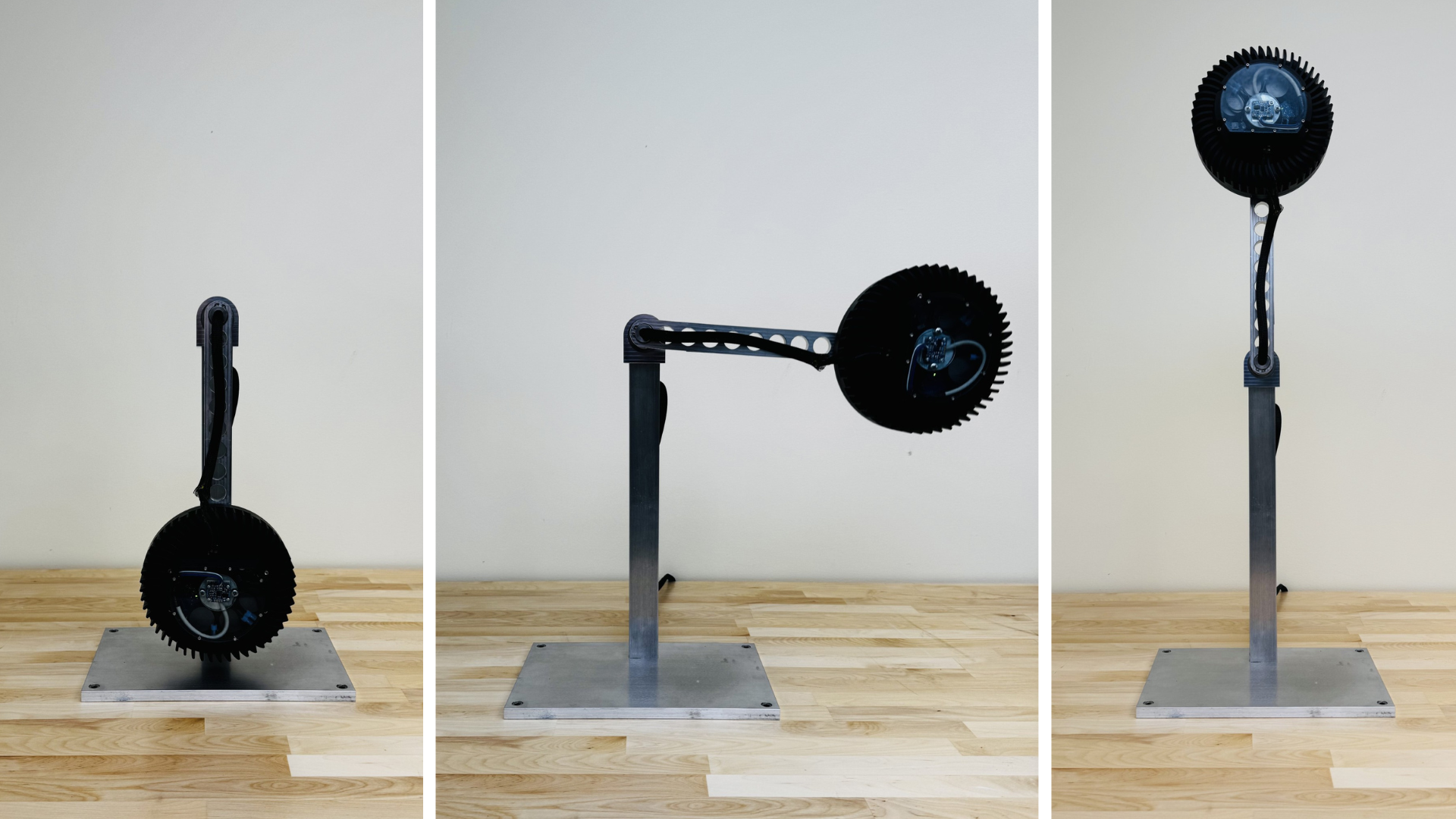
Figure 1: ECM’s reaction wheel inverted pendulum in motion. The ECM axial flux motor rotor acts as the reaction wheel itself, combining torque generation and momentum storage in a single component.
ECM’s air-core PCB stator is free of soft magnetic materials, giving it an extremely fast electrical time constant, high specific peak torque capacity, and fine torque resolution. The absence of cogging torque allows even the smallest commanded torque changes to produce smooth, predictable motion, which is critical for precise attitude control near an equilibrium point. The low vibration and smooth torque characteristics also make the technology well-suited to sensitive instrumentation, precision optical systems, and the thermal challenges of space environments.
To illustrate these capabilities in practice, ECM101 details the full design and performance of a reaction wheel demonstration system built in ECM’s lab: a reaction wheel inverted pendulum, a classical closed-loop stabilization problem. The system uses an ECM motor acting against its own rotor as the flywheel, controlling the angular position of a pendulum arm through precise torque commands. By eliminating separate coupling mechanisms and bearings, the integrated design reduces mechanical complexity and rotational losses while naturally increasing the effective moment of inertia of the system. A video of the demonstrator in operation can be seen here.
The paper provides a complete mathematical framework covering system dynamics, energy-based swing-up control, and linearized balancing control, giving engineers a practical foundation to design and implement their own reaction wheel systems using ECM technology. A motor and controller equivalent to those used in the demonstration are available as regularly stocked items from ECM.
What Engineers Will Find in ECM101:
-
A full system overview of the reaction wheel inverted pendulum demonstrator, including mechanical configuration, electrical and control architecture, and IMU feedback integration
-
An explanation of how inertia can be designed directly into an ECM axial flux motor rotor, eliminating separate flywheel components and simplifying system assembly
-
System dynamics equations and energy-based swing-up control law, with a damping term to keep rotor speed centered and minimize stored energy at the upright equilibrium
-
A linearized PID balancing control law that regulates both pendulum and wheel angles and velocities, accounting for measurement bias
-
Video of the reaction wheel inverted pendulum in operation, demonstrating the smooth and stable torque control achievable with ECM’s air-core PCB stator technology
Availability
ECM101 is available now at www.pcbstator.com. Engineers developing satellite attitude control systems, stabilization platforms, or advanced robotics are encouraged to download ECM101 and explore how software-defined PCB Stator motors can simplify reaction wheel architectures while improving control fidelity and system efficiency.
About ECM PCB Stator Tech
ECM PCB Stator Tech delivers the only full-stack platform for electric motor innovation, empowering partners to design, prototype, and optimize next-generation PCB Stator motors with precision and speed. With PrintStator Motor CAD and patented axial flux hardware, ECM enables the development of compact, efficient, and quiet motors for applications across HVAC, pumps, robotics, e-mobility, consumer electronics, aerospace, and more. ECM maintains offices in Boston (MA) and Bozeman (MT), with business development representatives in Europe. For more information, visit www.pcbstator.com.
Sales Inquiries
Chris Fielding – VP Applications Engineering – cfielding@pcbstator.com
Michael Fischer – EVP of Global Sales and Marketing – mfischer@pcbstator.com
Media Inquiries
ECM PCB Stator Tech
Sam Jones – Director of Marketing and Communications
sjones@pcbstator.com
www.pcbstator.com
+1.617.340.3241
SOURCE: ECM PCB Stator Tech
View the original press release on ACCESS Newswire