53% of Americans carry credit card balances to cover essential living expenses, Achieve survey finds
PR Newswire
SAN MATEO, Calif., May 12, 2026
With inflation again on the rise, Achieve’s quarterly survey on household debt and credit conditions also found 35% of consumers face trouble making on-time debt payments
SAN MATEO, Calif., May 12, 2026 /PRNewswire/ — Over half (53%) of American consumers carry credit card balances to cover the rising cost of essential expenses, with 25% of consumers carrying these debts for 6 months or longer, according to a new survey by Achieve, the leader in digital personal finance.
The March 2026 survey of 2,000 consumers was conducted by Achieve’s think tank, the Achieve Center for Consumer Insights, and complements the Federal Reserve Bank of New York’s upcoming Quarterly Report on Household Debt and Credit by providing qualitative insights into consumer borrowing and debt.
“Rising credit card usage does not signal financial strength. For many, it’s a coping mechanism to make ends meet,” said Austin Kilgore, analyst for the Achieve Center for Consumer Insights. “Increasingly, we’re seeing Americans rely on revolving debt not for discretionary spending, but to manage the rising cost of everyday necessities.”
Achieve’s survey found 57% of consumers estimate it would take 6 months or longer to pay off all their short-term, unsecured debt like credit cards, buy now pay later loans, personal loans and medical debt. That’s up slightly from 55% in the first quarter 2026 edition of Achieve’s survey. Other consumer insights from the survey include:
- 51% are “uncomfortable” or “extremely uncomfortable” using credit cards for essential expenses and not paying the balance off right away.
- 48% can’t realistically reduce spending on their bills and utilities, an indication that for struggling consumers, they’ve already cut back as much as they can.
- 35% say it’s “very difficult” or “difficult” to maintain on-time debt payments.
- 35% say it’s “very difficult” or “difficult” to maintain on-time debt payments.
These ongoing challenges come at a time when recent spikes in inflation have put fresh strain on household budgets. Annual inflation has increased over 3% the past two months, largely due to higher energy costs, according to the latest Bureau of Labor Statistics Consumer Price Index data. As the cost-of-living gap continues to put pressure on household finances, consumers say a confluence of factors contribute to the challenge of making ends meet.
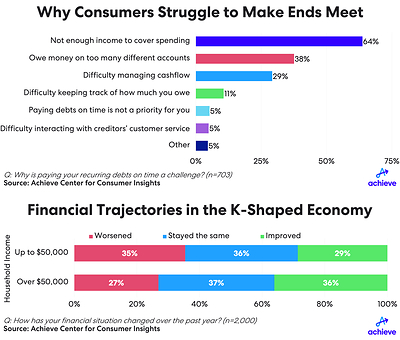
Among survey respondents who say it’s “very difficult” or “difficult” to maintain on-time debt payments, 64% say their household doesn’t earn enough income to cover spending, while 38% point to owing money on too many different accounts and 29% say it’s challenging aligning pay day at their jobs and due dates on their debts.
|
Why Consumers Struggle to Make Ends Meet |
|
|
Reasons for paying debts on time |
Percent of Consumers |
|
Not enough income to cover spending |
64 % |
|
Owe money on too many different accounts |
38 % |
|
Difficulty managing cashflow |
29 % |
|
Difficulty keeping track of how much you owe |
11 % |
|
Paying debts on time is not a priority for you |
5 % |
|
Difficulty interacting with creditors’ customer service |
5 % |
|
Other |
5 % |
|
Q: Why is paying your recurring debts on time a challenge? (n=703) |
|
Achieve’s survey shows many consumers aren’t using credit cards primarily as a convenience tool. They’re using them as a financial bridge to cover recurring necessities. That’s a meaningful distinction because it often leads to persistent balances, higher interest costs and greater long-term financial strain.
“Credit card spending can look strong on the surface, but the underlying question is what consumers are actually putting on those cards,” Kilgore said. “For many households, higher balances are less a sign of economic optimism and more a sign that wages and savings are struggling to keep pace with essential expenses like groceries, utilities and housing.”
Income’s Influence on the K-Shaped Economy
In a sign of the continued divergence of the “K-shaped” economic conditions — where affluent households thrive and lower-income households languish — Achieve’s survey highlights how consumer perceptions about their financial trajectory are strongly influenced by household income.
Consumers with household incomes up to $50,000 were more likely to report their financial situation getting worse over the past year (35%), than consumers with incomes over $50,000 (27%). Conversely, 29% of respondents with incomes up to $50,000 said their situation improved, compared to 36% of consumers with incomes over $50,000.
|
Financial Trajectories in the K-Shaped Economy |
|||
|
Household Income Level |
Worsened |
Stayed the same |
Improved |
|
Over $50,000 |
27 % |
37 % |
36 % |
|
Up to $50,000 |
35 % |
36 % |
29 % |
|
Q: How has your financial situation changed over the past year? (n=2,000) |
|||
Methodology:
The data presented is from a March 2026 survey of 2,000 U.S. consumers ages 18 and older with an active account for one or more of the following categories of consumer debt: auto loan; major credit card with a minimum outstanding balance of $100; first-lien mortgage; home equity line of credit (HELOC); student loan; and other (unsecured personal loan, store-branded credit card, buy now, pay later loan, or closed-end home equity loan).
About the Achieve Center for Consumer Insights
The Achieve Center for Consumer Insights is a think tank that leverages Achieve’s team of digital personal finance experts to provide a view into the state of consumer finances. In addition to sharing insights gleaned from Achieve’s proprietary data and analytics, the Achieve Center for Consumer Insights publishes in-depth research, bespoke data and thoughtful commentary in support of Achieve’s mission of helping everyday people get on the path to a better financial future.
About Achieve
Achieve, THE digital personal finance company, helps everyday people get on, and stay on, the path to a better financial future. Achieve pairs proprietary data and analytics with personalized support to offer personal loans, home equity loans, debt relief and debt consolidation, along with financial tips and education and free mobile apps: Achieve MoLO® (Money Left Over) and Achieve GOOD™ (Get Out Of Debt). Achieve is frequently recognized for providing top-rated customer experience and satisfaction by both consumers and leading personal finance review platforms and has 2,200 dedicated teammates across the country, with hubs in Arizona, California, Florida and Texas.
Achieve refers to the global organization and may denote one or more affiliates of Achieve Company, including Achieve.com, Equal Housing Opportunity (NMLS ID #138464); Achieve Home Loans, Equal Housing Opportunity (NMLS ID #1810501); Achieve Personal Loans (NMLS ID #227977); Freedom Debt Relief (NMLS ID # 1248929); and Freedom Financial Asset Management (CRD #170229).
Contacts
Austin Kilgore
214-908-5097
Elina Tarkazikis
 View original content to download multimedia:https://www.prnewswire.com/news-releases/53-of-americans-carry-credit-card-balances-to-cover-essential-living-expenses-achieve-survey-finds-302769650.html
SOURCE Achieve