

Originally Posted On: https://www.theboxery.com/blog/how-to-replace-foam-peanuts-with-eco-friendly-shipping-supplies-that-still-cushion-well/
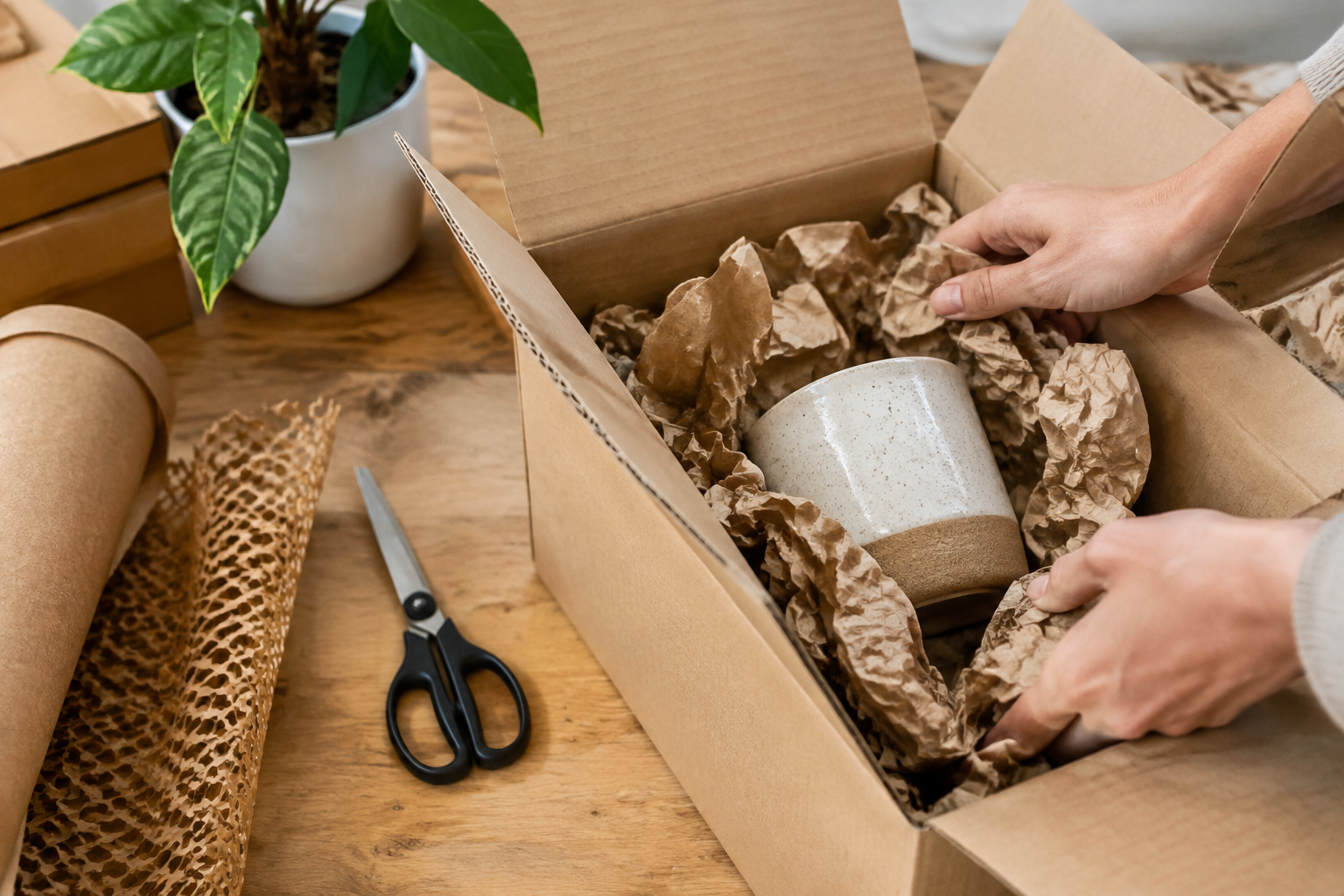
What You'll Need
Gather this before you touch a single box. Most of it you already own.
-
Tools: a postal or kitchen scale, a tape measure, a box cutter, and a marker for labeling test parcels.
-
Materials: kraft paper rolls or crinkle paper, corrugated mailers, kraft bubble mailers, 32 ECT corrugated boxes in two or three sizes close to your products, chipboard pads, and paper tape.
-
Prerequisites: a list of your top five products by order count, plus your last 30 days of damage claims and returns. That's your baseline.
-
Skills: basic measuring and packing. No engineering degree required. You only need to read an ECT rating and tell recycled content from a vague "eco" label.
-
Test supplies: three sample parcels per product, so figure on roughly 15 test packages if you're checking five items.
-
Time required: about 2 to 3 hours for the audit, sizing, and drop tests. Then 30 days of tracking to confirm the switch works.
One tip: order small case quantities first. You'll learn which sizes actually fit before you commit to a bigger stock.
Foam peanuts are the packing material everybody loves to hate. They cling to your hands, skitter across the floor, and sit in a landfill for centuries. Yet plenty of sellers still scoop them into boxes because they're cheap and they work.
Here's the catch. Switching to eco-friendly shipping supplies doesn't have to mean paying more per package or watching damage claims climb. For an Etsy, Shopify, or eBay shop moving 100 to 1,000 orders a month, the swap is mostly a matter of fit. Pick a box that's closer to your product's size and you need far less filler to begin with.
Paper-based fill, corrugated inserts, and kraft mailers can cushion just as well as peanuts when you match them to what you actually ship. Some of that "green" packaging on the market is just clever labeling, though. So what really holds up in transit, and how do you tell the real thing from the marketing?
What You'll Achieve and What You Need Before You Start
The goal: swap foam peanuts without raising your per-package spend or your damage rate
A seller shipping 400 orders a month opens a carton of ceramic mugs and finds peanuts clinging to everything, the floor, her sleeves. She wants them gone. But she won't accept more breakage or a bigger spend on each parcel to get there.
That's the target. Replace loose-fill foam with eco friendly shipping supplies that cushion just as well, and hold both your per-package spend and your damage rate flat. Right-sizing does most of the work here. Less empty space means less filler to buy in the first place.
Materials checklist: kraft paper, corrugated mailers, right-sized boxes, paper tape, a scale and a tape measure
Gather these before you pack a single order:
-
Kraft paper for crinkled void fill and wrapping
-
Corrugated mailers for flat, low-profile items like books and apparel
-
Right-sized boxes with a snug fit around the product
-
Paper tape so the whole carton stays recyclable
-
A scale and tape measure to check weight and dimensions
Soft goods don't need a box at all. For those, poly bags for shipping keep postage low, and you can still pair them with paper for anything that needs a little padding.
Step 1: Audit What You Ship and Where Foam Peanuts Are Doing the Work
Most sellers can't say which orders actually need foam peanuts. Start there. Pull your last 50 orders and sort them by product, because the pattern shows up fast.
Weigh and measure your top five products
Grab a scale and a tape measure. Record weight and length, width and height for each of your five best sellers, then note which box holds it and how much empty space is left. Gaps bigger than an inch on any side are where peanuts crept in. Right-sizing the box often removes the need for fill, which makes Eco-friendly packaging far easier to adopt. Rattling items are the red flag.
Flag fragile items versus soft goods like clothing that never needed fill at all
Sort every product into two piles. Fragile goods, such as glass, ceramics and candles, need real cushioning. Soft goods don't.
-
Needs cushioning: glassware, pottery, jars, electronics
-
Needs no fill: shirts, knitwear, scarves, soft toys
Clothing sellers can skip the box entirely.
Soft items ride well in shipping poly bags, which cuts weight and removes the fill question. That leaves a short list of fragile products, and that list is the only place your eco friendly shipping supplies budget really has to work.
Step 2: Right-Size Your Boxes and Mailers First to Cut Void Fill by Half
Why a smaller box beats any cushioning material
Why buy better filler when you can buy less empty space? The cleanest void fill is the kind you never need. Swap an oversized carton for a snug one — the paper crinkle, air pillows, and peanuts mostly disappear. Searching for shipping supplies near me usually turns up 10 to 15 box sizes. That's the trap. Online catalogs with 1,000+ sizes let you match the box to the product.
Matching products to corrugated mailers, kraft bubble mailers, and standard 32 ECT boxes
-
Corrugated mailers: books, apparel, prints, and flat items. They ship flat, recycle curbside, and need almost no filler.
-
Kraft bubble mailers: jewelry, cosmetics, and small fragile goods. Browse these shipping mailers when a box is overkill.
-
Standard 32 ECT boxes: items up to roughly 65 lbs. Made with high recycled content and fully recyclable.
How dimensional weight punishes empty space
Carriers bill on size, not just weight. A 5 lb item in a 20x20x20 box can be charged as 24 lbs. Air is the expensive part. Measure the product, add about an inch per side for cushioning, and pick the closest size. Do that, and void fill drops by half or more.
Step 3: Pick the Right Eco Friendly Packaging Materials for Each Product Type
Corrugated cardboard is among the most recycled materials in the U.S., and that's exactly why it should anchor your swap away from foam. Match the material to the product. One filler won't cover everything.
Kraft paper and crinkle paper for general void fill
Crumple two or three sheets per gap. Crinkle paper works well for soft goods, books, and candles. It's cheap, curbside recyclable, and doesn't cling like foam peanuts.
Corrugated inserts and chipboard pads for rigid support
Heavier items need structure, not fluff. Cut corrugated inserts to lock a product in place, or slip a chipboard pad under flat goods like prints. Browse discounted Packaging materials if you're testing sizes on a small budget.
Kraft bubble mailers and paper tape for small fragile items such as jewelry and handmade goods
Small and delicate? Try kraft paper mailers with a cushioned lining, sealed with paper tape. Check the lining, though, because it's plastic.
Spotting greenwashing: recycled content, recyclable, compostable, and biodegradable are not the same thing
-
Recycled content: made from used material.
-
Recyclable: can be recycled where facilities exist.
-
Compostable: breaks down under specific composting conditions.
-
Biodegradable: breaks down eventually, with no set timeline.
Ask for specifics. Vague green claims on eco friendly shipping supplies deserve skepticism.
Step 4: Pack and Drop-Test the New Setup Before You Ship It to Customers
Paper cushioning doesn't fail because it's weaker than foam peanuts. It fails because nobody tested it. Skip that step and the first real drop test happens on a customer's porch.
Start by packing three test parcels per product with your new materials. Use the same box, tape, and void fill you plan to ship. Crinkled kraft paper works well here, and so do cushioned kraft mailers for smaller items.
Then run a simple test on each parcel:
-
Shake it hard. Listen for rattling or shifting.
-
Drop it flat, on an edge, and on a corner from about waist height.
-
Open it. Check for movement, crushed corners, and scuffed product.
Weigh each packed parcel too.
Heavier fill can push a package into a higher rate tier.
Mistakes That Sink a Good Switch
-
Under-filling. Loose paper compresses in transit. Pack it firmly enough that the item can't slide.
-
Over-wrapping. Extra layers add weight and waste without adding protection.
-
Mixing tape types. Plastic tape on a paper-based box can block recycling. Match your tape to the box.
-
Skipping the weight check. Always confirm the final weight before you print labels.
Fix whatever failed, then retest. Only ship once all three parcels pass.
Step 5: Lock In Your Supplies and Verify the Switch Is Working
A seller shipping 400 orders a month swaps foam peanuts for kraft paper and paper-based mailers on a Monday. By week three, two customers mention a dented corner. Is the new setup failing? Or is it normal noise? Without numbers, nobody can say.
Track Three Numbers for 30 Days
Keep a simple spreadsheet. Log these every week:
-
Damage claims filed with the carrier or the marketplace
-
Returns that cite broken or crushed items
-
Postage per order, compared with your pre-switch average
Compare against your last 30 days of foam peanut shipments. If damage holds steady and postage drops or stays flat, the switch works. If damage climbs, add one more layer of paper void fill before changing materials.
Reorder by the Case
Running out mid-peak is the fastest way to crawl back to foam. Order in case quantities and set a reorder point at roughly two weeks of stock. For flat items, Shipping envelopes store flat and take little room, which helps when your packing space is a spare closet.
Next Steps
Once the numbers look good, add custom printed branding to boxes or mailers. Or keep it cheap: slip a short recycling note into the packing slip. Tell buyers the box and paper fill go straight into curbside recycling.
How-To FAQ
How long does it take to replace foam peanuts with eco-friendly shipping supplies?
Plan on about two to three weeks from audit to full switch. Spend a day weighing and measuring your top products, a few days testing packs, then ship test orders for roughly 30 days while you watch damage and return numbers. Order samples early so you aren't waiting on supplies mid-test.
Will paper void fill cushion as well as foam peanuts?
Yes, if you pack it tight and the box is the right size. Crinkled kraft paper works by bracing the item, so loose, half-filled paper fails where peanuts would have squeezed in. For heavy or fragile items, wrap the product first, then fill every gap until nothing shifts when you shake the box. Skip this and you'll see damage claims.
What's the easiest way to avoid raising my per-package spend?
-
Shrink the box first. A tighter fit means less fill and lower dimensional weight.
-
Move soft goods to mailers. Clothing and textiles rarely need fill at all.
-
Buy by the case. Case quantities of boxes and mailers beat small packs.
Most sellers find the savings from right-sizing offset the cost of paper fill.
Can I recycle a box packed with paper fill and paper tape?
Yes — that's the whole point of the setup. Corrugated, kraft paper, and paper tape all go in curbside paper recycling together, so your customer doesn't have to sort anything. Plastic tape and foam peanuts are what cause trouble. Check local rules, since programs differ, but an all-paper pack is the safest bet.
How do I know if a "green" product is greenwashing?
Look for specifics, not vague labels. "Recycled content" should come with a percentage, "recyclable" means it can go in a standard bin, and "compostable" or "biodegradable" usually require conditions most customers don't have. If a supplier can't say which one applies and why, treat the claim with suspicion.
Is a drop test really necessary?
Yes. It takes ten minutes and catches problems before customers do. Drop each test parcel from about waist height onto a flat side and a corner, shake it, then open it and check for movement, crushed corners, or scuffed products. If anything moved, add fill or step down a box size and test again.
Foam peanuts don't have to stay in the supply closet just because nothing else seems to cushion as cheaply. Sellers who make the switch tend to find the same thing: the biggest savings come from the box, not the filler. A snug fit means less material to buy, less weight to pay postage on, and fewer rattling parts to break.
The testing step matters just as much. Three packed parcels, one drop, one shake. That's a small effort next to a stack of refund requests. And when the paper, corrugated inserts, and kraft bubble mailers hold up, the shift to eco-friendly shipping supplies becomes a quiet upgrade rather than a gamble. Watch the claims on the label, too. Recycled content, recyclable, and compostable are three different promises.
Start today with one product. Weigh it, measure it, and pick the smallest box or mailer that fits. Then order a case of kraft paper and a case of that size from The Boxery, pack your three test parcels, and track damage and postage for 30 days. The numbers will tell you whether to roll it out to the rest of your catalog.