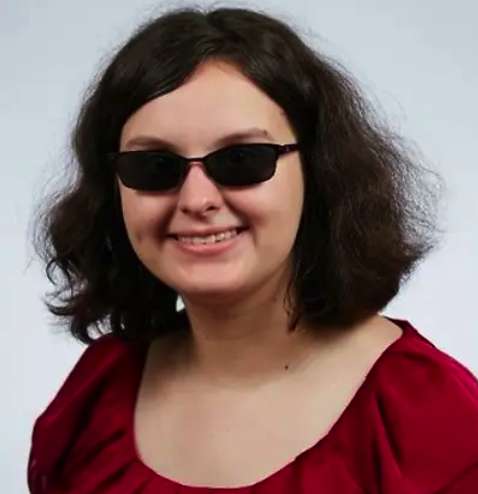
CORVALLIS, OR, UNITED STATES, August 19, 2026 /EINPresswire.com/ — Education Researcher, Curriculum Designer, and Accessibility Advocate Helps Create More Inclusive STEM Learning Experiences for Students With Disabilities
Ashley Elizabeth Neybert, PhD, is an education researcher, curriculum designer, and accessibility advocate working to make science education more inclusive for blind and low-vision students. Based in Corvallis, Oregon, Ashley serves as Lead Curriculum Specialist at Independence Science, where she develops accessible science curricula and supports educators seeking to create more inclusive laboratory learning environments.
Ashley’s commitment to science accessibility grew from personal experience. While studying chemistry in college, she began experiencing vision loss and was suddenly faced with the challenge of continuing her education while navigating rapidly changing circumstances. A pivotal connection with a mentor working in accessibility introduced Ashley to talking laboratory equipment and adaptive science tools designed to support blind students and scientists.
As Ashley gained experience in the field, she began to recognize that the challenges she encountered were not isolated. Instead, they reflected a broader systemic gap in science education, where students with disabilities could face barriers to laboratory participation, learning materials, and opportunities to pursue STEM careers.
That realization ultimately led Ashley to doctoral research at Oregon State University, where she completed her PhD in Education with a focus on science accessibility. Her dissertation brought together one of the largest known collections of lived experiences from blind individuals in science, documenting stories spanning multiple decades. Through this research, Ashley sought to better understand the barriers people encountered and identify potential long-term solutions for creating more inclusive STEM education.
Today, Ashley applies that research and personal experience to her work at Independence Science. As Lead Curriculum Specialist, she designs accessible science curricula and consults on inclusive education practices. Her work extends beyond supporting blind and low-vision learners, encompassing students with a wide range of learning and physical needs, including autistic students and those with physical disabilities.
At the heart of Ashley’s philosophy is the belief that accessibility benefits everyone. By designing science learning experiences with accessibility in mind from the beginning, educators can create environments that provide more students with opportunities to participate, experiment, discover, and develop confidence in STEM.
Ashley’s path to this work has been shaped not only by education and professional experience, but also by the lessons her grandparents instilled in her from childhood. She attributes much of her success to them and the stories they shared, including The Little Train That Could and Nestor the Long-Eared Christmas Donkey.
Her grandparents would tell her that she was like the little train trying to make it up the hill. The journey might be difficult, but the important thing was to keep trying. Other stories taught Ashley that being different can sometimes be challenging, but those differences can ultimately become strengths.
Those lessons became deeply embedded in Ashley from an early age. The characters in the stories sometimes cried or wanted to give up, but Ashley learned that those emotions were part of the journey and did not mean someone had failed. Her grandparents taught her that life could sometimes be difficult or sad, while also reinforcing the idea that the very qualities that make someone different can eventually become their greatest assets.
That perspective has remained particularly meaningful throughout Ashley’s own experiences with vision loss and her career in accessibility. Rather than viewing difference solely as an obstacle, she has developed a professional philosophy centered on identifying ways to remove unnecessary barriers and create opportunities for people to participate fully.
Ashley also has a message for young women entering science, education, and related fields: remember that you are better than you think you are.
She recognizes that many women become accustomed to supporting the people around them, encouraging friends and family by telling them they are beautiful, capable, and deserving of respect. Yet, she believes women can struggle to extend that same compassion toward themselves.
Ashley encourages young women to give themselves the same respect, love, and understanding they readily offer to others. She emphasizes the importance of taking breaks without feeling guilty and making time to recharge and spend time with friends. While she acknowledges that she still struggles with this herself, she believes recognizing personal needs is essential to long-term well-being and success.
Her own experiences have given her a clear understanding of how easily self-care can become an afterthought. Ashley recalls moments when she would be hungry and consider buying an inexpensive meal but convince herself she did not have the money, only to immediately spend significantly more on something for her sister without hesitation. For her, that experience captures the importance of recognizing that she deserves the same generosity she naturally extends to others.
Through her research, curriculum development, advocacy, and lived experience, Ashley continues to challenge assumptions about who belongs in science. Her work demonstrates that accessibility is not simply about accommodating individual students—it is about creating learning environments where differences are anticipated, respected, and supported.
As she continues advancing inclusive STEM education, Ashley Elizabeth Neybert remains committed to ensuring that disability does not become a reason a student is excluded from the opportunity to explore science. Through thoughtful design, research-informed practices, and persistent advocacy, she is helping build a future in which more students can see themselves as capable participants in science and discovery.
Learn More about Ashley Elizabeth Neybert:
Through her Influential Women profile, https://influentialwomen.com/connect/ashley-neybert or through her profile on Independence Science, https://independencescience.com/who-we-are/
Influential Women
Influential Women provides a platform where women from all backgrounds can connect, share their perspectives, and create content that empowers themselves and others. Through storytelling, thought leadership, and creative expression, Influential Women amplifies voices that inspire change.
Editorial Team
Influential Women
email us here
Legal Disclaimer:
EIN Presswire provides this news content “as is” without warranty of any kind. We do not accept any responsibility or liability
for the accuracy, content, images, videos, licenses, completeness, legality, or reliability of the information contained in this
article. If you have any complaints or copyright issues related to this article, kindly contact the author above.

Media gallery