Key Takeaways
- Local service businesses lose up to 62% of potential revenue from missed calls, with each unanswered call costing between $275-$1,200 in lost business, depending on the industry
- AI-powered call handling and lead qualification systems can reclaim 4-6 hours per day while enabling faster response times that increase conversions
- The critical 5-minute response window determines whether leads convert or move to competitors
- 24/7 automated systems handle customer engagement without owner dependency, allowing business growth beyond personal capacity limits
- Service companies implementing AI systems can potentially reduce missed calls by up to 70% and increase booked appointments by 25% within three months
The phone rings. Again. It’s the fourth call this hour, and there are still three voicemails from yesterday to return. Sound familiar? For local service business owners, the phone represents both the lifeline to growth and the chain that prevents it. The constant pressure to be available creates an exhausting cycle in which business success depends entirely on personal availability.
The Phone Dependency Trap That’s Killing Your Growth
Every successful local service business faces the same paradox. Inbound calls represent the highest-converting leads possible – qualified prospects actively seeking services. Yet the requirement to personally handle every call creates an invisible ceiling that no amount of hard work can break through.
The trap operates with mathematical precision. Business owners can handle a finite number of calls per day. When demand exceeds that capacity, calls go unanswered. When calls go unanswered, leads disappear to competitors. When revenue dips due to lost leads, owners work harder to compensate, becoming even busier and missing more calls. The cycle reinforces itself endlessly.
A recent gap analysis of an established Atlanta roofing company revealed the stark reality of this dependency. Despite strong market presence and excellent service quality, 40% of their inbound calls went unanswered simply because the team was busy serving existing clients. Autonomous Growth’s analysis showed that with calls costing $200 to generate and average project values of $9,000, every missed call represented approximately $1,800 in lost revenue. The phone was simultaneously their greatest asset and their biggest leak.
What Business Owners Lose Every Day From Missed Calls
1. Revenue Lost from the 62% of Unanswered Calls
Industry data reveals that small service businesses miss an average of 62% of inbound calls during business hours. For companies generating 50 calls per week, this means 31 potential customers receive no response. At conservative conversion rates of 15-20%, those missed opportunities amount to 5-6 lost clients per week. For businesses with average project values of $2,500, the weekly revenue loss exceeds $15,000.
The mathematics becomes more painful when calculated annually. Missing just five qualified leads per week can cost a service business significant annual revenue – potentially hundreds of thousands of dollars, depending on project values and conversion rates. These aren’t cold prospects – they’re motivated customers who found the business, researched the services, and made the effort to call. They represent the highest-intent leads possible, making their loss particularly devastating.
2. The 5-Minute Window That Determines Win or Loss
Speed-to-lead research demonstrates that businesses responding to inquiries within five minutes are 100 times more likely to make contact than those waiting 30 minutes, and 7 times more likely to qualify leads than those waiting 60 minutes. The difference is dramatic – companies achieving five-minute response times see significantly higher conversion rates than those with hour-long delays.
This window reflects modern customer expectations. When someone searches for emergency plumbing services at 9 PM, they’re not interested in waiting until morning for a callback. They’ll continue calling competitors until someone answers. The first business to respond professionally and offer immediate scheduling typically wins the job, regardless of pricing differences.
3. After-Hours Leads Going to Competitors
Local service emergencies don’t respect business hours. Burst pipes occur on weekends. HVAC systems fail during holidays. Roofs leak during storms. Yet most service businesses capture leads only during standard operating hours, ceding the entire after-hours market to competitors with 24/7 availability.
After-hours leads often represent the highest-value opportunities. Emergency situations create urgency, reducing price sensitivity and increasing customer loyalty. Businesses capturing these opportunities build relationships with clients who remember being helped during critical moments, generating referrals and repeat business for years afterward.
AI Systems That Replace Your Phone Dependency
AI Voice Agents for 24/7 Call Answering
Modern AI voice agents handle inbound calls with human-like conversational quality, answering every call instantly, regardless of time or current call volume. These systems qualify leads by asking relevant questions, provide accurate information about services and pricing, and book appointments directly into scheduling systems.
The technology handles complex scenarios that previously required human intervention. When a caller describes an emergency plumbing situation, the AI agent can determine urgency level, schedule immediate service calls, and provide interim guidance while technicians travel to the location. Unlike human staff, AI agents never get tired, never miss calls due to illness, and maintain consistent professionalism regardless of call volume or caller attitude.
Advanced systems integrate with existing business tools, update customer relationship management platforms, send confirmation messages, and automatically trigger follow-up sequences. The entire lead capture and qualification process operates without human involvement while maintaining the personal touch that converts prospects into clients.
Instant Website Response with AI Chatbots
Website visitors expect immediate responses to inquiries. Studies show that 90% of customers want instant answers to their questions, yet most service businesses take 60+ minutes to respond to online form submissions. During this delay, prospects research competitors and often book services elsewhere.
AI chatbots eliminate response delays entirely by engaging website visitors within seconds of their arrival. These systems answer common questions about services, pricing, and availability while capturing contact information and scheduling appointments. The chatbots operate continuously, ensuring no website visitor leaves without receiving attention, regardless of when they browse.
Integration with scheduling systems allows chatbots to offer real appointment times rather than generic “we’ll call you back” messages. Visitors can book confirmed service appointments before leaving the website, dramatically improving conversion rates from website traffic.
AI-Powered Review Request and Response Automation
Positive reviews drive local business success, yet manually requesting reviews after each completed job creates an administrative burden that often gets forgotten during busy periods. Automated review systems eliminate this inconsistency by triggering review requests immediately after job completion.
These systems send personalized messages thanking customers for their business and providing direct links to preferred review platforms. Follow-up sequences ensure non-respondents receive gentle reminders while avoiding spam-like frequency. The automation generates steady streams of fresh reviews that improve online visibility and build trust with future prospects.
Advanced systems also monitor review platforms for new feedback and respond appropriately to both positive and negative reviews, maintaining active engagement with the local community while protecting business reputation.
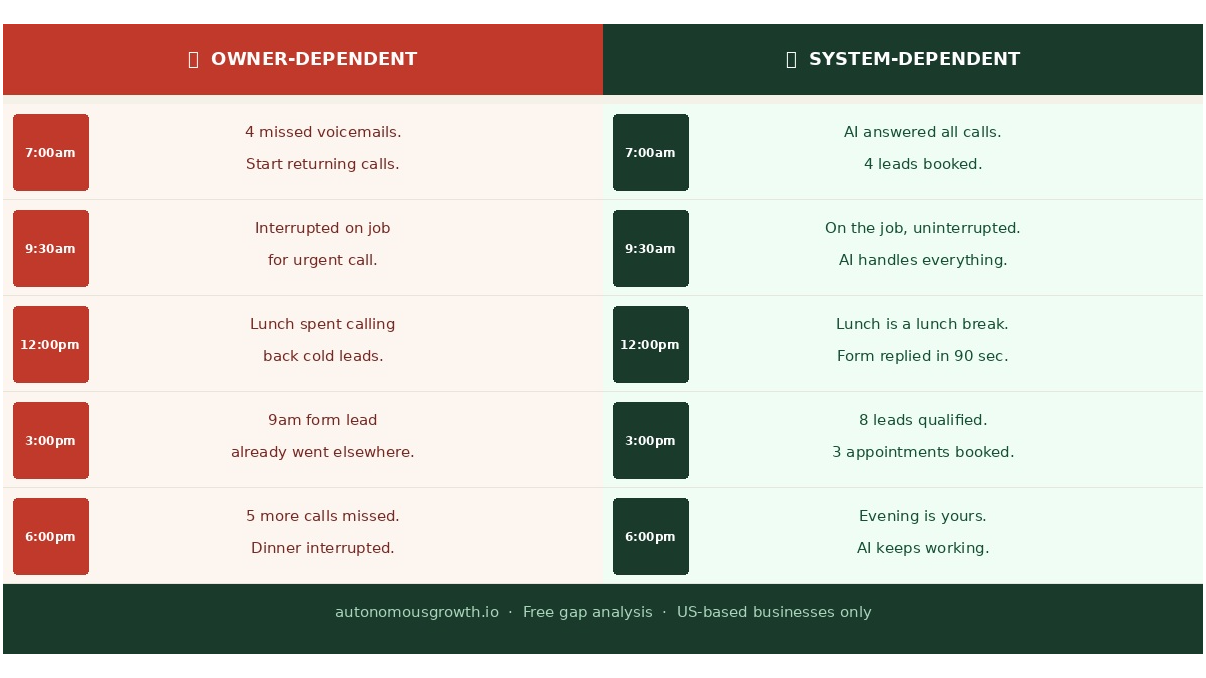
A Day in Your Life – Before vs After AI Implementation
Morning: From Voicemail Chase to Dashboard Review
Before AI Implementation: The day begins at 6:30 AM with a check of overnight voicemails. Four messages require callbacks, including two emergency situations that couldn’t wait until morning. The first hour involves returning calls to prospects who may have already booked with faster-responding competitors. Breakfast gets cold while explaining service offerings that prospects could have learned from the website.
After AI Implementation: Morning coffee comes with reviewing the overnight dashboard. The AI voice agent handled 12 calls, qualifying 8 genuine leads and booking 5 confirmed appointments. Emergency calls were triaged appropriately: genuine emergencies received immediate contact from dispatchers, while non-urgent issues were scheduled for regular business hours. The pipeline is full before the workday officially begins.
Workday: Uninterrupted Service vs Constant Phone Interruptions
Before AI Implementation: Job site productivity suffers from constant phone interruptions. Every twenty minutes brings another call requiring immediate attention – quote requests, scheduling questions, or existing customers with concerns. Half-completed tasks stretch into full days as attention fragments between active work and phone management.
After AI Implementation: On-site work flows uninterrupted while AI systems handle all inbound communication. Calls are answered professionally, leads are qualified and scheduled, and urgent issues are escalated appropriately. Productivity increases dramatically when focus can remain on service delivery rather than phone management.
Evening: Reclaimed Time vs Extended Work Hours
Before AI Implementation: Evening hours extend work as missed calls require return attempts. Dinner conversations are interrupted by prospects calling during “normal” hours. Family time competes with the constant pressure to remain available for potential business opportunities.
After AI Implementation: Evening returns to personal life as AI systems continue to operate around the clock. After-hours leads are captured, qualified, and scheduled without owner involvement. Family dinners remain uninterrupted while business growth continues automatically.
Real Numbers: 8-15 Hours Reclaimed and Improved Conversions
Time Breakdown: What Gets Automated
Detailed time tracking reveals where business owners lose hours to phone management. Returning missed calls can consume 2-3 hours daily, following up on website forms may require 45 minutes, and answering repetitive prospect questions takes another 1-2 hours. Combined with manual review chasing, owners can spend 4-6 hours daily on tasks that AI systems handle automatically.
This time liberation compounds over weeks and months. Reclaiming 25-30 hours weekly provides bandwidth for business development activities that actually grow the company – building partnerships, expanding service offerings, or developing team capabilities. The time saved from phone management becomes time invested in scaling operations.
Conversion Rate Improvements from Speed-to-Lead
Response time directly correlates with conversion success. Businesses responding within five minutes are significantly more likely to convert leads than those taking sixty minutes or longer. AI systems consistently achieve sub-minute response times, regardless of existing call volume or time of day.
Internal case studies show remarkable improvements after implementing AI-powered call handling. Within three months, one plumbing company reduced missed calls by 70% while increasing booked appointments by 25%. The speed advantage allowed them to win jobs from larger competitors who couldn’t match their response times.
The conversion improvement extends beyond initial response speed. AI systems provide consistent information quality and professional presentation that human staff sometimes struggle to maintain during busy periods. Every prospect receives the same high-quality experience regardless of timing or circumstances.
Your Business Runs Without You Being Chained to the Phone
The ultimate goal isn’t eliminating human involvement – it’s eliminating human dependency on routine tasks that technology handles more effectively. AI systems manage the volume, speed, and consistency requirements of modern lead capture while preserving human involvement in complex decisions and relationship-building.
This transformation allows business owners to focus on activities that actually require their expertise and attention. Instead of spending hours returning routine calls, they can evaluate expansion opportunities, develop team skills, or improve service quality. The business grows because leadership attention shifts from operational maintenance to strategic development.
When systems handle predictable tasks automatically, businesses become more resilient and scalable. Revenue growth doesn’t require proportional increases in owner availability. Teams can focus on service delivery rather than phone management. The entire operation becomes more professional and efficient while reducing stress and improving work-life balance for everyone involved.
The phone dependency that currently limits business growth becomes a competitive advantage when properly systematized. Companies implementing these technologies consistently outperform competitors who remain tied to manual processes, winning more leads while investing less time in lead management.
Autonomous Growth’s AI-powered automation systems can eliminate your reliance on your phone while increasing lead conversion rates for your local service business.
Autonomous Growth ( part of RReputatioNN )
109 Sint-Lenaartsesteenweg #1
1
Rijkevorsel
Antwerpen
2310
Belgium