SHANNON, CLARE, IRELAND, May 22, 2026 /EINPresswire.com/ — Announcing a new publication from Opto-Electronic Advances; DOI 10.29026/oea.2026.250329.
Dissipative Kerr solitons, which are generated in high-quality-factor (Q) optical microresonators, serve as an advanced type of laser source. Their frequency components are arranged uniformly, like the teeth of a comb; therefore, they are often referred to as microcombs. Due to the low loss, compact size, and strong nonlinearity of high-Q optical microresonators, microcombs can achieve spacing down to tens of gigahertz (GHz) or even terahertz (THz). These combs offer significant advantages, including low power consumption, a miniature size (coin-sized), and low noise. This demonstrates substantial application potential in precision measurement, high-speed communication, and microwave photonics. Furthermore, the fabrication process of optical microresonators is compatible with existing complementary metal oxide semiconductor (CMOS) technology, which facilitates large-scale production and offers broad market prospects in the industrial sector.
In metrology applications, such as ranging and spectral analysis, dual-comb detection systems are commonly used to improve measurement accuracy and resolution. Compared to traditional independent dual-comb structures, multistable solitons can generate two sets of optical combs with stable frequency differences within a single microresonator simultaneously. This approach significantly reduces system cost and complexity while achieving superior dual-comb coherence. Conversely, the generation process of multistable solitons is accompanied by rich dynamic phenomena, such as soliton switching and collisions. Studying these dynamics expands our fundamental understanding of soliton interaction mechanisms and aids in optimizing the generation and control processes of multistable microcombs. This improves the flexibility of integrated single-cavity dual-comb sources and advances their application development. However, multistable soliton dynamics occur over extremely short timescales (in the microsecond range), exhibit excessively narrow temporal pulses (in the sub-picosecond range), and demand substantial frequency bandwidth (in the terahertz range). Although alternative approaches such as the temporal magnifier and optical sampling have been used to characterize soliton dynamics, they are unable to capture the phase information or enable continuous tracking of dynamics across multiple round-trip periods. Real-time full-field characterization of their temporal and spectral evolution dynamics is a critical challenge that requires urgent breakthroughs.
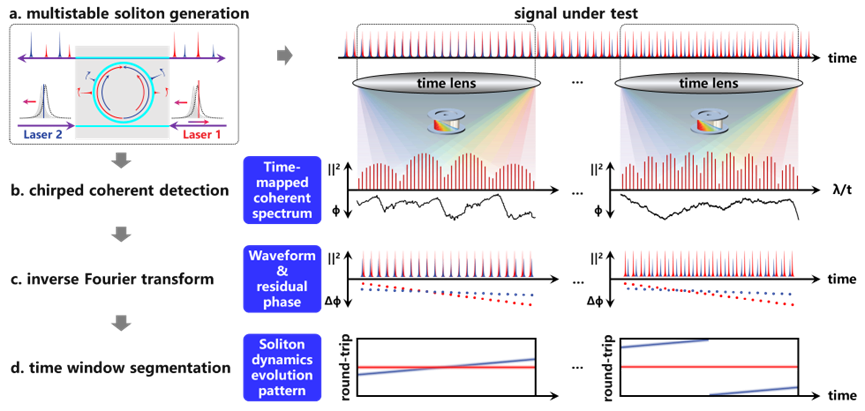
The authors of this article created a multistable microcombs generation platform using multicolor pumping. To overcome the challenges of observing microresonator soliton dynamics, Prof. Chi Zhang’s team developed a novel chirped coherent detection scheme that combines the functionalities of both a spectrometer and an oscilloscope. This system enables the real-time characterization of the full-field spectral and temporal evolution of multistable solitons (i.e., intensity and phase). As illustrated in Figure 1, the core innovation lies in the seamless integration of the time-frequency mapping advantage of dispersive Fourier transform (DFT) and the full-field information detection capability of coherent detection. This approach creates a virtual time-lens in the digital domain, which enables the real-time measurement of the full-field spectral information of the signal under test. Finally, an inverse Fourier transform is applied to reconstruct the temporal waveform and phase of the signal. This approach circumvents the bandwidth limitations inherent in direct temporal detection and addresses issues associated with the complex structure and high detection noise of conventional optical time-lenses. Operating at a 20-MHz frame rate, the chirped coherent detection achieves a spectral resolution of 28 pm across a 25-nm bandwidth and a temporal resolution of 280 fs within a 520-ps temporal window.
The research group observed multistable soliton collision phenomena, including mutual penetration and fusion, as well as multistable soliton switching phenomena using the proposed system, as shown in Figures 2 and 3, respectively. The multistable soliton switching phenomenon is a significant new discovery in microresonator soliton dynamics research.
Chirped coherent detection allows for the full-field measurement in both the spectral and temporal domains, thereby establishing a reliable foundation for the precise manipulation of diverse multistable soliton dynamics. The results will offer new fundamental insights into multistable soliton behavior in microresonators and facilitate further advances in dual-comb applications, including high-precision light ranging and spectroscopy.
Keywords: microcomb, multistable soliton dynamics, coherent detection, real-time characterization
# # # # # #
Chi Zhang is a professor and Ph.D. Supervisor at the Wuhan National Laboratory for Optoelectronics, Huazhong University of Science and Technology. His research primarily focuses on ultrafast optical measurement techniques, and he has developed high-frame-rate spectrometers and ultra-bandwidth real-time optical oscilloscopes. He has published over 100 SCI-indexed papers in journals such as Science Advances, Light: Science & Applications, and Opto-Electronic Advances. As the principal investigator, he has led key projects, general programs, and youth funds under the National Natural Science Foundation of China, as well as technology development projects for Huawei Technologies Co., Ltd. He has been honored with several awards, including the National Young Top-notch Talent, Hubei Provincial Outstanding Young Talent, Chutian Scholar, and Guanggu Industrial Professor. Additionally, he serves as a Youth Editorial Board Member for Acta Optica Sinica.
Wenfu Zhang is a researcher and Ph.D. Supervisor at the Xi’an Institute of Optics and Precision Mechanics, Chinese Academy of Sciences (CAS). His research focuses on photonic integrated circuits, including silicon-based optical interconnect chips, integrated microcavity optical frequency combs, and narrow-linewidth semiconductor lasers. He has led over 10 major projects, including the National Natural Science Foundation of China (NSFC) Youth Fund Project (Category A), the National Key R&D Program of China, a key project under JKW’s special initiative, the CAS Strategic Priority Research Program (Category B), and the Young Elite Talent Program under the Central Organization Department’s WR Plan. In the past five years, he has published over 10 papers as corresponding author (including co-corresponding author) in journals such as Nature Communications, Science Advances and Physical Review Letters, and has applied for more than 20 patents (including 5 U.S. patents).
Xinliang Zhang is a professor and Ph.D. supervisor at Huazhong University of Science and Technology. His research focuses on optoelectronic devices and integration, particularly key components and integrated chips for high-speed optical communication networks, optical computing, and ultrafast optical measurement. Zhang has received the National Science Fund for Distinguished Young Scholars, the National “Ten Thousand Talents Plan” Leading Talent in Science and Technology Innovation, and the Ministry of Education’s Major Talent Program awards. Zhang is a fellow of the Chinese Optical Society and the Optical Society of America (OSA). He currently serves as secretary-general of the optical engineering discipline review panel under the academic degrees committee of the state council, deputy director of the teaching guidance subcommittee for optoelectronic information science and engineering under the ministry of education, and standing council member of both the Chinese optical society and the Chinese institute of electronics. He has received five provincial/ministerial-level First Prizes in Natural Sciences, as well as one National Teaching Achievement First Prize and one Second Prize.
# # # # # #
Opto-Electronic Advances (OEA) is a high-impact, open access, peer reviewed SCI journal with an impact factor of 22.4 (Journal Citation Reports 2024). OEA has been indexed in SCI, EI, DOAJ, Scopus, CA and ICI databases, and expanded its Editorial Board to 41 members from 17 countries.
# # # # # #
More information: http://www.oejournal.org/oea
Editorial Board: http://www.oejournal.org/oea/editorialboard/list
All issues available in the online archive (http://www.oejournal.org/oea/archive).
Submissions to OEA may be made using ScholarOne (https://mc03.manuscriptcentral.com/oea).
ISSN: 2096-4579
CN: 51-1781/TN
Contact Us: oea@ioe.ac.cn
Twitter: @OptoElectronAdv (https://twitter.com/OptoElectronAdv?lang=en)
WeChat: OE_Journal
# # # # # #
Liao ZC, Cai YC, Li L et al. Multistable soliton dynamics in an optical microresonator. Opto-Electron Adv 9, 250329 (2026). DOI: 10.29026/oea.2026.250329
Opto-Electronic Advances Editorial Office
Opto-Electronic Advances
+86 591 2286 1222
email us here
Legal Disclaimer:
EIN Presswire provides this news content “as is” without warranty of any kind. We do not accept any responsibility or liability
for the accuracy, content, images, videos, licenses, completeness, legality, or reliability of the information contained in this
article. If you have any complaints or copyright issues related to this article, kindly contact the author above.

Media gallery